The Nancy Meyers aesthetic is what happens when you take a comfortable, expensive, mostly white house and light it like it's always four o'clock on a September afternoon. That's it. That's the trick. The slipcovers, the rattan, the piles of hardbacks, the enormous kitchen with nothing on the counters: all of it is real and all of it is copyable. The light is not. The light is a crew of twelve people and a truck full of equipment parked outside the window.
I've watched Something's Gotta Give more times than I'll admit in writing. When "coastal grandmother" turned into a phrase in 2022, the whole internet decided it meant Diane Keaton in a turtleneck in that Hamptons house, and fair. But I've spent three years now trying to build that feeling into a narrow Charleston house with normal windows and normal money, and I've worked out which parts of the Meyers formula are load-bearing and which parts are set dressing. This is the room-by-room version.
What is the Nancy Meyers aesthetic, in one paragraph?
Traditional bones, neutral palette, a lot of white and cream, natural textures (linen, wicker, unfinished wood, stone), rooms that look lived in but never messy, and a kind of quiet wealth that never shows a logo. Big kitchens. Big sofas. Books everywhere. Fresh flowers in every room, always from the garden, never from a florist. Nothing matches exactly, but everything belongs. Production designer Jon Hutman built most of these houses on sound stages and then made them feel like they'd been lived in for forty years. That last part is the thing to study.
The kitchen: what to copy
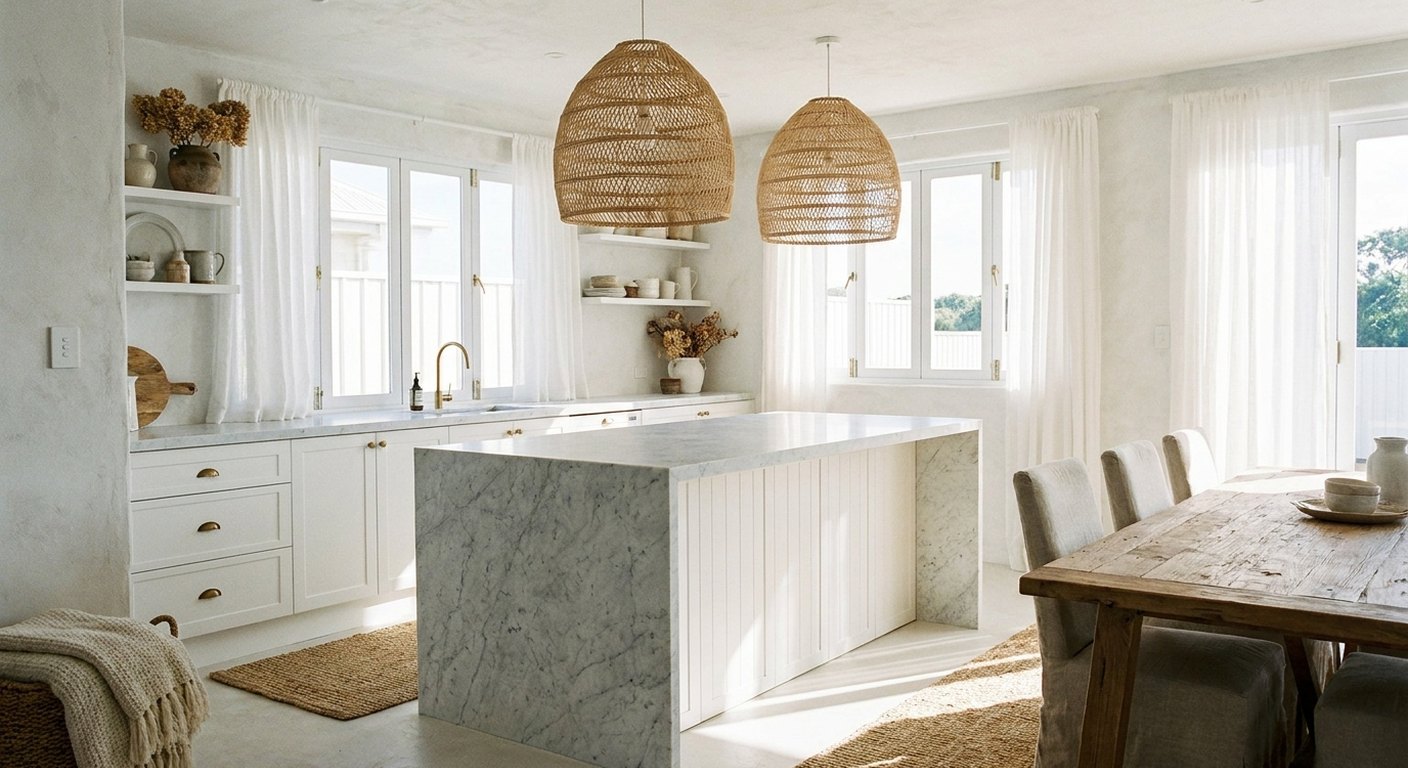
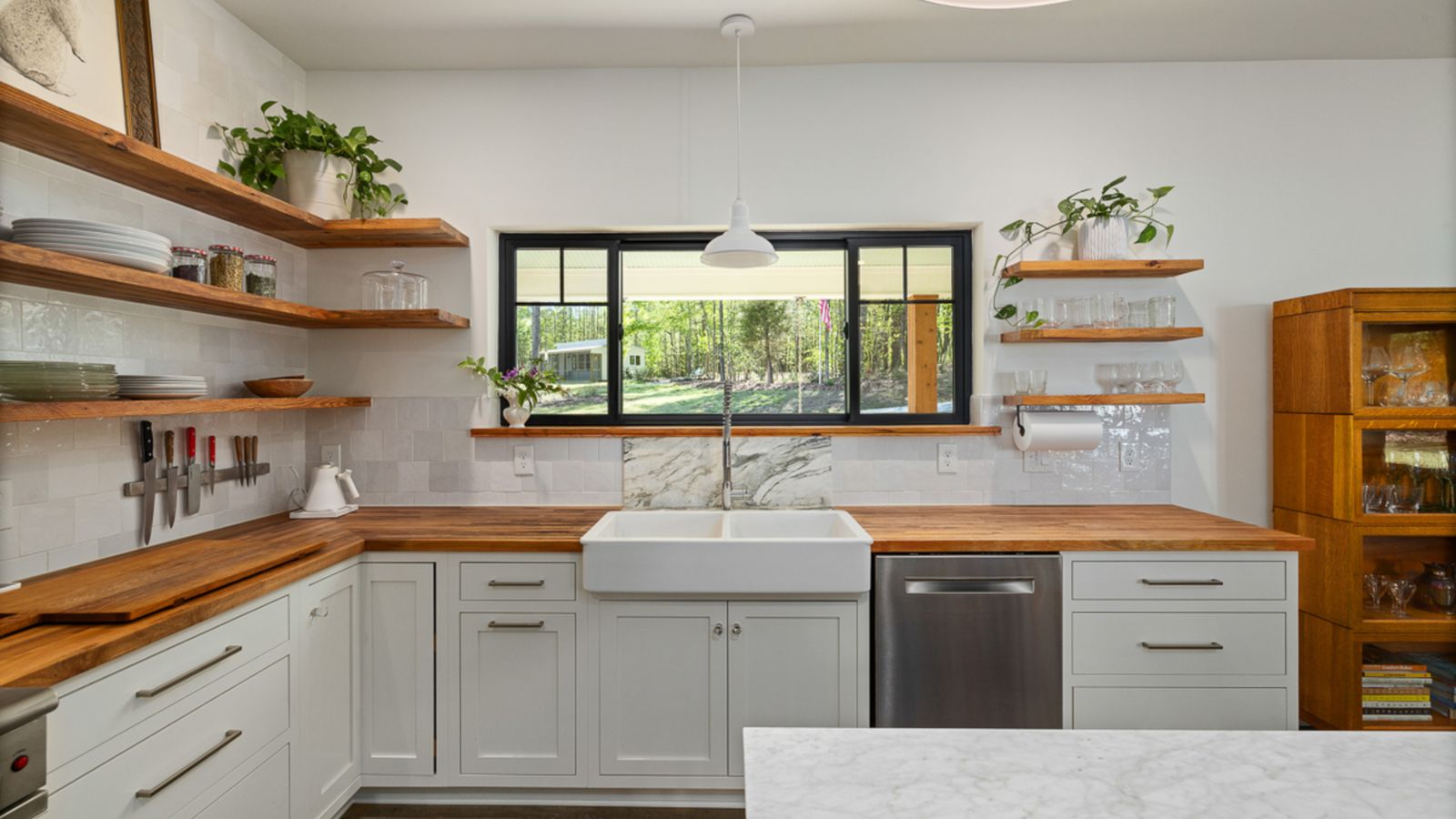
Start here, because the kitchen is the room people mean when they say "Nancy Meyers." The Something's Gotta Give kitchen is white cabinets, dark counters, a big farmhouse sink under the window, open shelves with white dishes, and a long island with stools. The It's Complicated kitchen is warmer, with a wood-topped island, but it's the same idea.
Copy the empty counters. This is the single biggest thing. In every Meyers kitchen the counters hold a bowl of lemons, a wooden board, maybe a pot of herbs, and nothing else. No coffee maker. No knife block. No paper towel holder. That's not realistic, but it's more achievable than you'd think if you build a landing spot for the ugly stuff. We put the toaster and the coffee machine in a cabinet with a lift-up door. Cost us $310 for the cabinet hardware and a weekend. The kitchen looked twice as expensive the next morning.
Copy the open shelving, but only for things you use every day. White dinner plates, glasses, mugs. The set decorators filled those shelves with pieces that all read as "old and white" but weren't a set. I did the same from thrift stores over about a year and a half, and I wrote about that in the thrifting post. Total spend for a full shelf of mismatched ironstone: under $90.
Copy the pendants over the island, but not the ones in the film. The Something's Gotta Give kitchen has small, simple, dark metal pendants that almost disappear. What matters is that there are two of them, hung low, at about 32 inches above the counter, and that they're on a dimmer. In our kitchen I used two rattan pendants over the island, which I covered in the whitewashed kitchen post, and if I did it again I'd go with something quieter. Rattan reads "coastal" a little loudly for a Meyers kitchen. A pair of small glass pendants would sit closer to the film.
What to skip
The scale. That kitchen is roughly the size of my entire first floor. Trying to force a 16-foot island into a normal kitchen produces a kitchen you can't walk around. Get the emptiness and the whiteness and the shelves. Let the size go.
The living room: what to copy
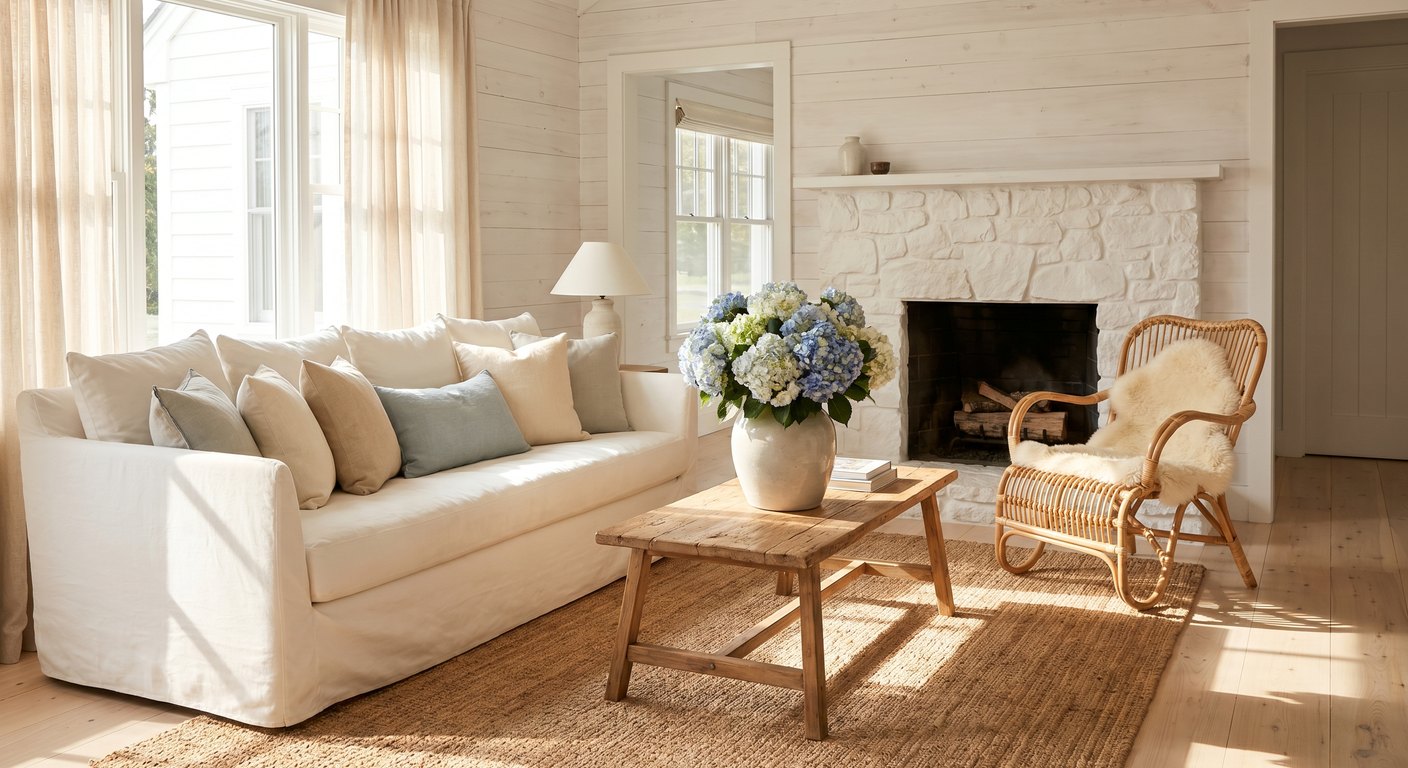
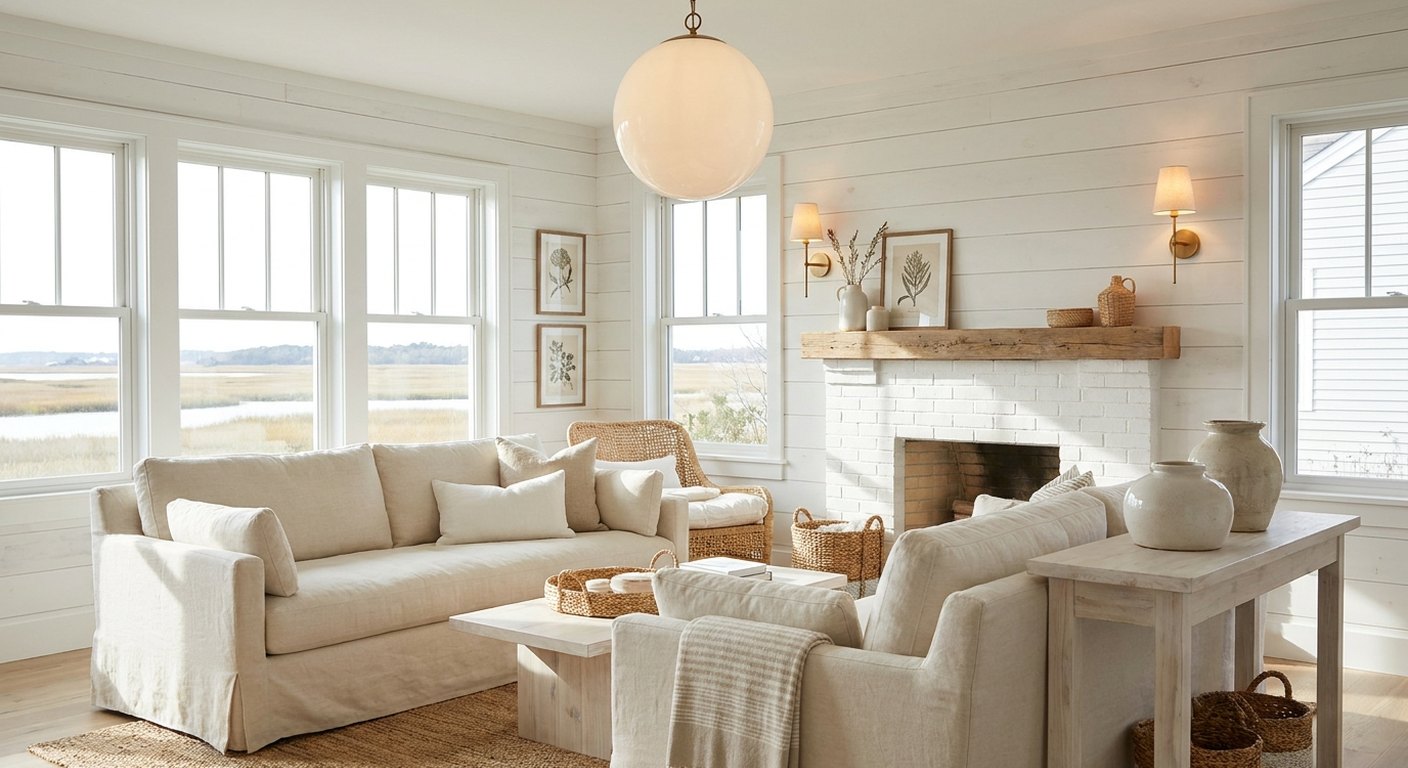
Erica Barry's living room in Something's Gotta Give has a deep white slipcovered sofa, two more slipcovered chairs, a big coffee table stacked with books, a fireplace, and windows on two sides looking at dune grass. The Holiday's Rosehill Cottage living room is the English version: smaller, lower, more pattern, same recipe.
Copy the slipcovers. I resisted this for years because "slipcover" sounded like something you put on a sofa to hide it. Then we had a baby and I understood. A washable white linen slipcover is the most practical thing you can own in a coastal climate, and it photographs like a million dollars. Ours came from a workroom in North Charleston, $640 for a three-seat sofa in a heavy Belgian linen, and it's been washed probably forty times. It looks better now than it did new.
Copy the book stacks. Not styled books with the spines turned in. Real books, the ones you actually read, in piles on the coffee table and the floor beside the chair. Meyers houses always have books in stacks because stacks look like someone lives there. Rows look like a library.
Copy the two-sided light. Meyers rooms almost always have windows on two walls, which is why they never look flat. If you only have one window wall, you can fake the second side with a big mirror on the opposite wall or a floor lamp in the far corner throwing light back toward the window. I did the mirror. It's a seven-foot antique leaner that cost $220 at an estate sale on Sullivan's Island and it made the room look like it had a window it doesn't have.
What to skip
The fireplace as the only light source at night. Those cozy evening scenes where the room glows and there are no visible lamps on? That's a lighting crew. In real life a room lit only by a fire is dark and you can't read in it. You need lamps, and the film never shows you the lamps because they'd be in the way of the camera.
The bedroom: what to copy
White bedding, always. Usually a headboard in a pale linen or a simple painted wood. A bench at the foot of the bed with a throw folded on it. Bedside tables that don't match, each with a lamp, a small stack of books, and a glass of water. The It's Complicated bedroom has French doors to a garden, which most of us can't manage, but the rest is easy.
Copy the bedside lamps at reading height. In the films the lamps are usually 26 to 28 inches tall with a wide drum or empire shade, so the bulb sits just above your shoulder when you're propped up. That's the correct height and most people buy lamps that are too short. I switched to bedside sconces a couple of years ago, which is a departure from the Meyers look but frees up the nightstand for the books and the water glass, so I'd argue it gets you closer in spirit.
Copy the layered white. White sheets, white duvet, a cream or oatmeal blanket folded at the foot, one pillow in a faded stripe or a washed-out blue. The trick is that the whites are all slightly different. Bright white sheets with a warm ivory duvet with a gray-white linen pillowcase. If they're all the same white it looks like a hotel.
What to skip
The morning light. Every Meyers bedroom wakes up to soft, even, golden light pouring through sheer curtains. Real morning light through sheers is either blinding or nonexistent depending on which way you face. We face east. Sheers were a disaster. We use unlined linen curtains now, and the room is still bright, but nobody gets a sunbeam in the eye at six.
The bathroom
Meyers bathrooms are white subway tile, a freestanding tub if the house can take it, a wood stool with a folded towel, and sconces on either side of the mirror rather than a bar light above it. That last detail is the one to steal. Sconces at eye level light your face evenly. A strip above the mirror lights your forehead and puts your eyes in shadow. I did our bathroom this way and wrote it up in the bathroom refresh post. Two glass sconces, $180 the pair, and the bathroom went from a place I got ready in to a place I lingered.
The home office
Erica Barry writes plays in a room with a big wood desk facing the window, a typewriter (in 2003, which was already a choice), and more books. Amanda's office in The Holiday is the LA version, cleaner and colder. The thing to copy is the desk facing the window. Most people push a desk against a wall to save space. Turn it around. Face the light. I did this in our marsh-facing office and it changed how much I wanted to sit there.
Add one good lamp at the desk, warm bulb, and turn off the overhead. Meyers offices never have an overhead light on. Neither should yours.
The light, and why it's the part you can't copy
I want to spend real time on this because it's where every "get the Nancy Meyers look" article goes wrong. They'll tell you the light is about big windows and white walls. Those help. But the reason those rooms glow is that a cinematographer put a 12,000-watt light outside the window, through a diffusion frame the size of a garage door, at a low angle, to fake late afternoon at ten in the morning. And then filled the shadows from inside with more lights you never see.
You can't do that. But you can do the version of it that fits in a house:
First, warm bulbs everywhere. 2700K, no exceptions. Every Meyers interior reads at roughly the color of a 2700K bulb, even in daytime scenes. I've written about why warm light matters so many times my family teases me, and this is the reason.
Second, lamps at three heights in every room. A floor lamp, a table lamp, and something lower, like a small lamp on a stack of books or a sconce. The film crew fakes that spread with equipment. You fake it with lamps. Three sources minimum, all warm, all on dimmers.
Third, no overhead light after dark. Ever. The single fastest way to kill the look is to flip on the ceiling fixture. Meyers rooms have ceiling fixtures, you'll see them in wide shots, but they're never on.
Fourth, and this is my own discovery rather than film wisdom: sheer white or oatmeal linen at the windows in the afternoon does about a third of what the diffusion frame does. It turns a hard patch of sun into a soft wash. It won't make your room look like the movie. It will make it look like the movie's little sister.
What the look actually costs
People assume this aesthetic requires a Hamptons budget, and the film houses did. But most of what makes it work is cheap or free: emptying the counters, stacking the books, washing the slipcovers, facing the desk toward the window, changing the bulbs. The expensive parts are the sofa and the kitchen, and you probably already own a sofa and a kitchen.
For what it's worth, our house was not a Meyers house when we bought it. It was a 1920s single house with brown trim, a dropped ceiling in the kitchen, and a fluorescent tube over the sink. What we did, over about four years, cost roughly $11,000 not counting the kitchen renovation, and most of that was the sofa, the slipcovers, the lamps, and paint. I'm not going to pretend that's nothing. But it's a fraction of what people assume.
Where coastal grandmother and Nancy Meyers part ways
They're cousins, not twins. Coastal grandmother, as I wrote in the post about what it means to me, is a little softer and a little more worn. It allows for faded fabric, chipped ironstone, the chair that's been in the family. Meyers houses are worn in a very expensive way, like a cashmere sweater that's been washed by hand. Coastal grandmother is worn like a cotton sweater that's been washed in the machine.
If you're choosing, choose coastal grandmother. It ages better, it survives children and dogs, and you don't need a set decorator to keep it looking right. Take the Meyers lighting rules, take the empty counters, take the slipcovers. Leave the perfection. Nobody's house looks like that at nine at night with the dishes undone, and the point of a house is to be the one you're actually in.
Shop this post: glass pendant lights for a quieter island, living room table lamps for the three-heights rule, and bedroom wall sconces to clear the nightstand