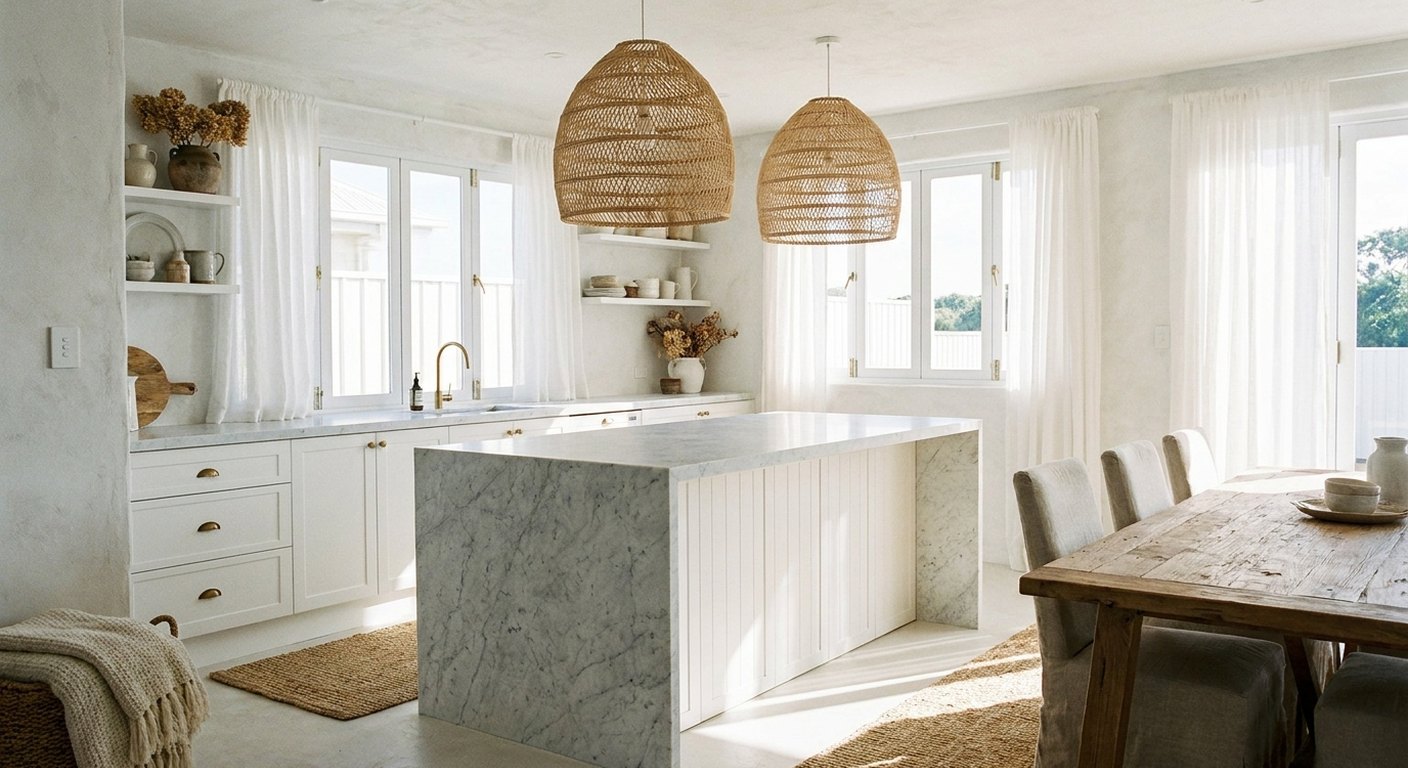
Our kitchen island is the spot where everything happens, homework, coffee, the unpacking of grocery bags, the long Sunday conversations. It deserved lighting that made it feel like a destination, not a workstation. In a whitewashed kitchen with a honed marble top, the answer was warm natural texture overhead.
Why Natural Material Over the Island
Against all that cool marble and white cabinetry, I wanted something with warmth and grain. A pair of wood and woven pendants brought exactly the right contrast, natural, tactile, a little organic. They keep the kitchen from feeling cold or showroom-perfect.
The Spacing Math
Our island is five feet long, so two island pendants were right. I centered the pair and left equal space at each end. Two pendants flanking the center of an island always look more balanced than trying to squeeze in a third.
Getting the Height Right
I hung the bottom of each shade 32 inches above the marble. High enough to see across the island comfortably, low enough that the light pools warmly on the counter. We tested it for a week at 34 inches and dropped them. The lower setting felt cozier.
Getting the Hanging Height Exactly Right
Island pendant height is where most coastal kitchens go slightly wrong, so it's worth measuring rather than eyeballing. The bottom of each shade should sit 30 to 36 inches above the countertop. And I landed on 32 inches after living with 34 for a week and finding it felt a touch too high over our standard 36-inch-tall island. The taller your ceilings, the higher in that range you can go, but the light gets weaker and the room loses its anchor the higher you float them. If anyone in your household is tall, stand them at the island before you finalize. The bottom of the shade should clear their sightline across the island so you're not looking through a glowing basket at dinner.
Spacing is the other half of the equation. For our five-foot island, two pendants centered with equal end margins looked balanced; the rule of one pendant per two feet of island would also support a third on a six-foot run. Keep at least six inches between fixtures, and center the whole grouping on the island, not on the room. The two are rarely the same.
Why Rattan Works Against Marble
Honed marble is cool, smooth, and a little formal; rattan is warm, textured, and relaxed. Putting them together is what keeps a whitewashed kitchen from feeling like a showroom. The woven shades cast soft, dappled shadows on the counter at night that a solid shade simply can't. And the natural fiber picks up the warm wood tones elsewhere in the room. If your island is a warmer stone or butcher block, you can flip this and reach for an opal glass pendant instead, letting the counter bring the warmth and the light stay crisp.
Layering in the Task Light
Beautiful pendants are mood lighting; a working kitchen also needs real task light, and that's a job for under-cabinet strips and a warm ceiling layer. I run warm-white LED strips under every upper cabinet, plugged into an outlet hidden inside one of them. So the counters are evenly lit for chopping without a single visible fixture. The Illuminating Engineering Society's lighting guidance is a useful reference if you want to understand why layered task light beats one bright ceiling fixture for a workspace. The short version: light where your hands are, not just over your head.
Bulbs, Dimmers, and the Whole-Kitchen Glow
Every bulb over the island and under the cabinets is 2700K warm white, and the pendants are on a dimmer. Bright for cooking, low and golden for a glass of wine after the kitchen's closed, one fixture, two completely different rooms. Keeping the temperature consistent between the pendants and the under-cabinet strips matters; mismatched bulb colors in a kitchen are jarring in a way most people feel but can't diagnose.
Keeping Woven Shades Clean in a Real Kitchen
The one honest caveat with rattan over an island: keep it back from the cooktop, because grease and woven fiber are not friends. Over an island with no burners, like ours, it's a non-issue, a quick dusting with a soft brush every few weeks is all they need. If your only pendant spot is directly over a range, choose glass or metal you can wipe down and save the rattan for a spot that stays clean.
What the Pendants Cost vs. A Renovation
Swapping a flush mount for two woven pendants is the cheapest way to make a kitchen look renovated without touching cabinets or counters. Two island pendants, a roll of under-cabinet LED strip, and a dimmer cost a fraction of any cabinet or countertop work. And they change how the room reads more than a backsplash would. If you're choosing where a small kitchen budget goes, lighting buys the most visible improvement per dollar.
Common Island-Lighting Mistakes
The usual errors: pendants hung too high so the light weakens and the island loses its anchor; pendants too small for the run, looking stranded over a long island; and skipping task light entirely. So the pretty woven shades leave the counters dim. Solve all three by measuring the height to 30-36 inches, sizing one pendant per two feet, and backing the mood light with hidden under-cabinet strips.
Pairing Pendants With Your Counter
Let the counter steer the shade. Cool marble loves the warmth of rattan or wood overhead; a warm butcher block or a busy stone is better balanced by a clean opal glass pendant. The goal is contrast, one cool surface and one warm material, or vice versa. So the island reads layered rather than matchy. That tension between smooth and textured is what makes a whitewashed kitchen feel collected.
Don't Forget the Counters
Natural-weave shades are really nice but soft on output, so under-cabinet strips do the task lighting. The pendants set the mood; the hidden strips do the chopping. That division of labor is the secret to a coastal kitchen that's both beautiful and usable.
Shop this post: pendant lights for the kitchen island and wood pendant lights