When we moved into our 1920s Charleston house, the living room had good bones and bad light. South-facing windows poured sunlight in all afternoon, and then a single brass dome on the ceiling took over at dusk and made the whole room feel like a waiting area. I wanted to keep the daytime softness going into the evening. That warm, sun-washed calm that makes a coastal room feel like a long exhale.
Here's how I built it, layer by layer.
Start With the Walls
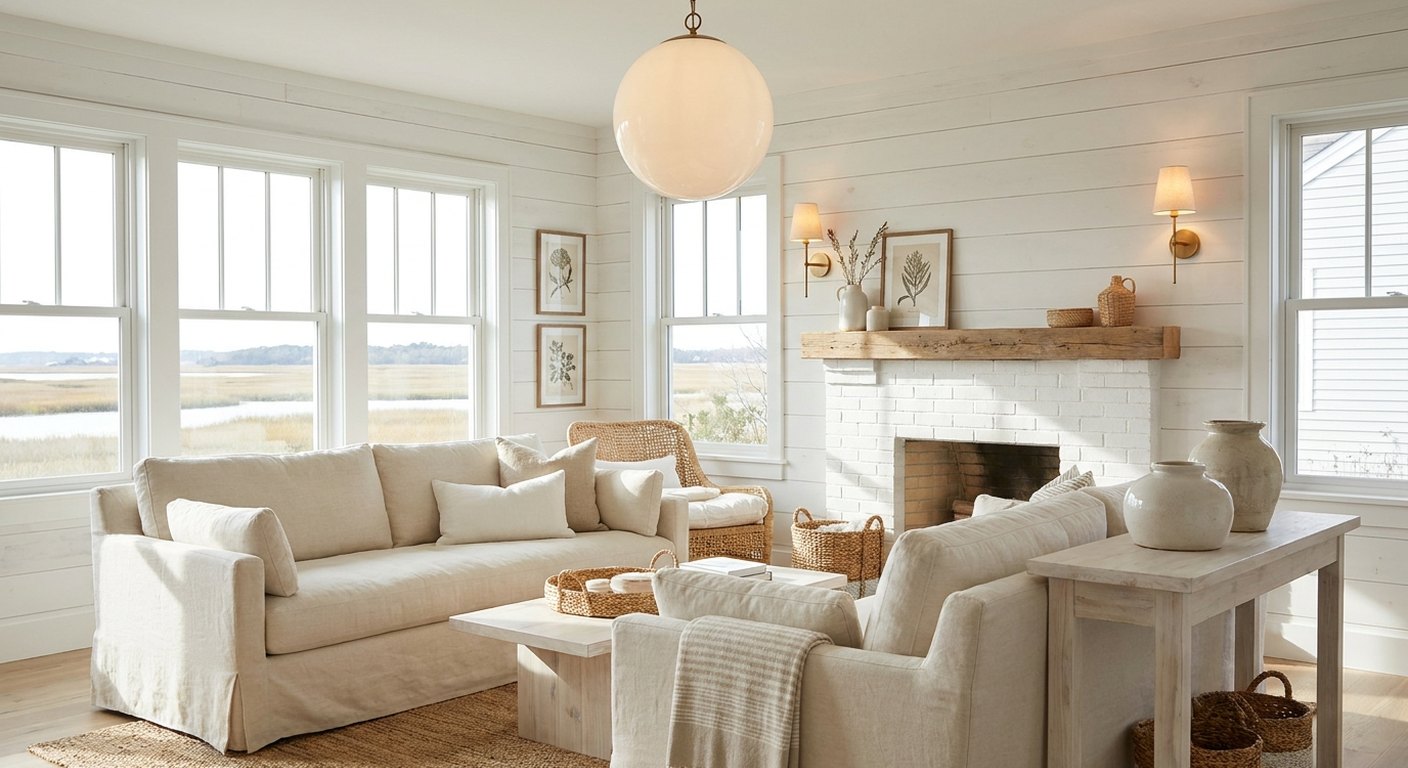
Everything began with whitewashed walls in a warm, slightly creamy white. Cool whites read blue and clinical; a warm white holds onto the afternoon light and glows at golden hour. Against that backdrop, every natural texture in the room. The rattan chair, the linen sofa, the oak coffee table, has somewhere to stand out.
The Overhead Layer
I replaced the brass dome with a soft pendant light with an opal glass shade. It diffuses light instead of throwing it, so the ceiling no longer feels like a spotlight. The shape is simple and Nordic, no ornament, just a clean curve that disappears into the room and lets the texture do the talking.
The Eye-Level Layer
This is the part people skip and shouldn't. Two wall sconces flanking the fireplace, mounted at 66 inches, completely changed the evening mood. Light at eye level is flattering and warm; light from the ceiling alone is functional and a little cold. The sconces are what make the room feel lit by lamplight even when it isn't.
Keep It Uncluttered
The last rule is restraint. Coastal calm falls apart the moment a room gets busy. One pendant, two sconces, a single rattan accent, plenty of negative space. The light has room to breathe, and so does everyone sitting in it.
Choosing the Right Pendant Scale for a Coastal Living Room
The most common mistake I see in a coastal living room is a pendant that's too small for the space. It floats up near the ceiling like an afterthought and the room never feels anchored. My rule of thumb: add the room's length and width in feet, and that sum in inches is a sensible pendant diameter. Our living room is roughly 14 by 16 feet, so a fixture in the 24-to-30-inch range reads as intentional rather than apologetic. If you're hanging it in the center of the room rather than over a table, keep the bottom of the fixture at least seven feet off the floor so no one walks into it. And a little higher in a room with nine-foot ceilings like ours.
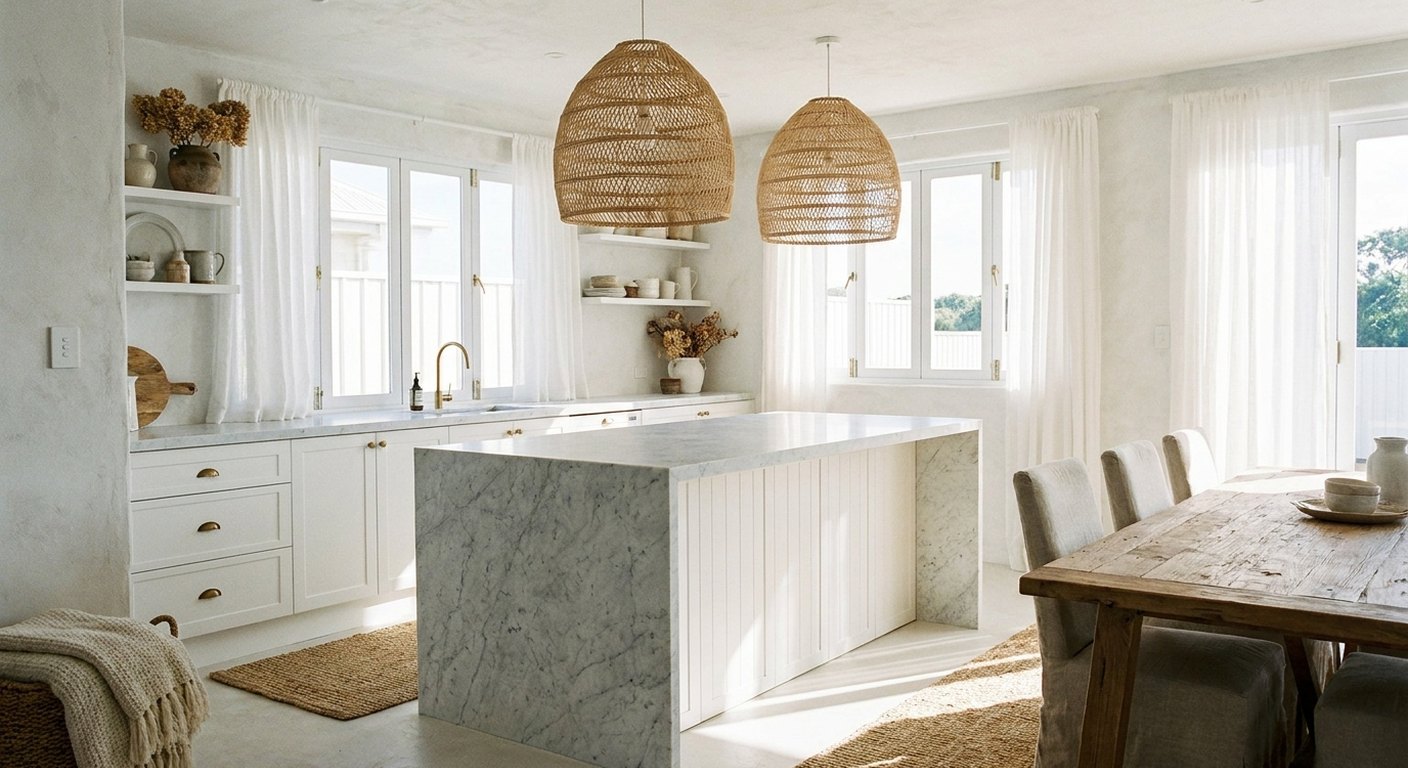
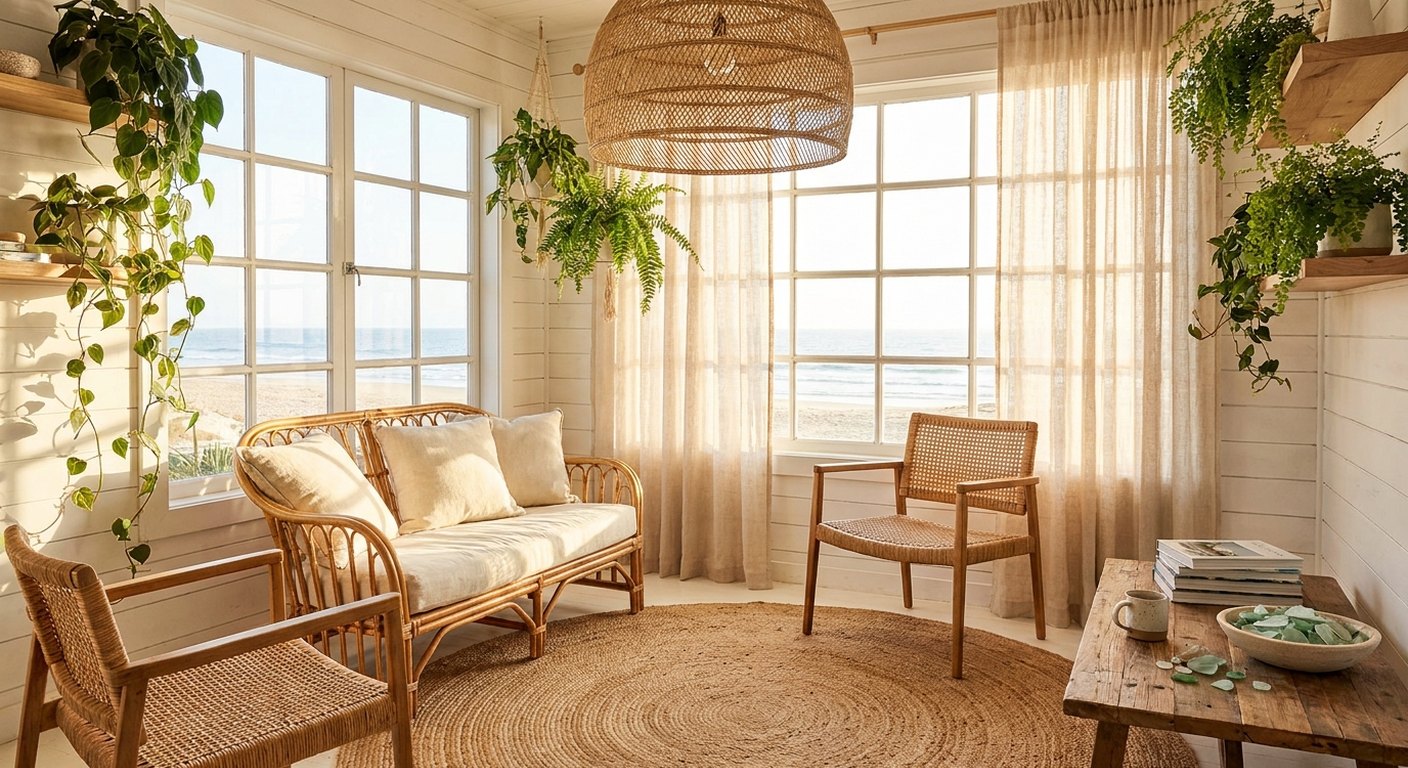
Material matters as much as size. An opal glass globe gives a soft, even glow and disappears into a pale room, while a woven rattan shade adds texture and a warmer, more dappled light. In a room that already has a lot of natural texture, our rattan chair, the jute rug, the linen slipcovers. I chose glass overhead so the textures on the furniture stay the stars. If your seating is more solid and upholstered, a woven or wood pendant overhead is a lovely way to bring the coastal texture up to the ceiling line.
Wall Sconce Placement, Measured
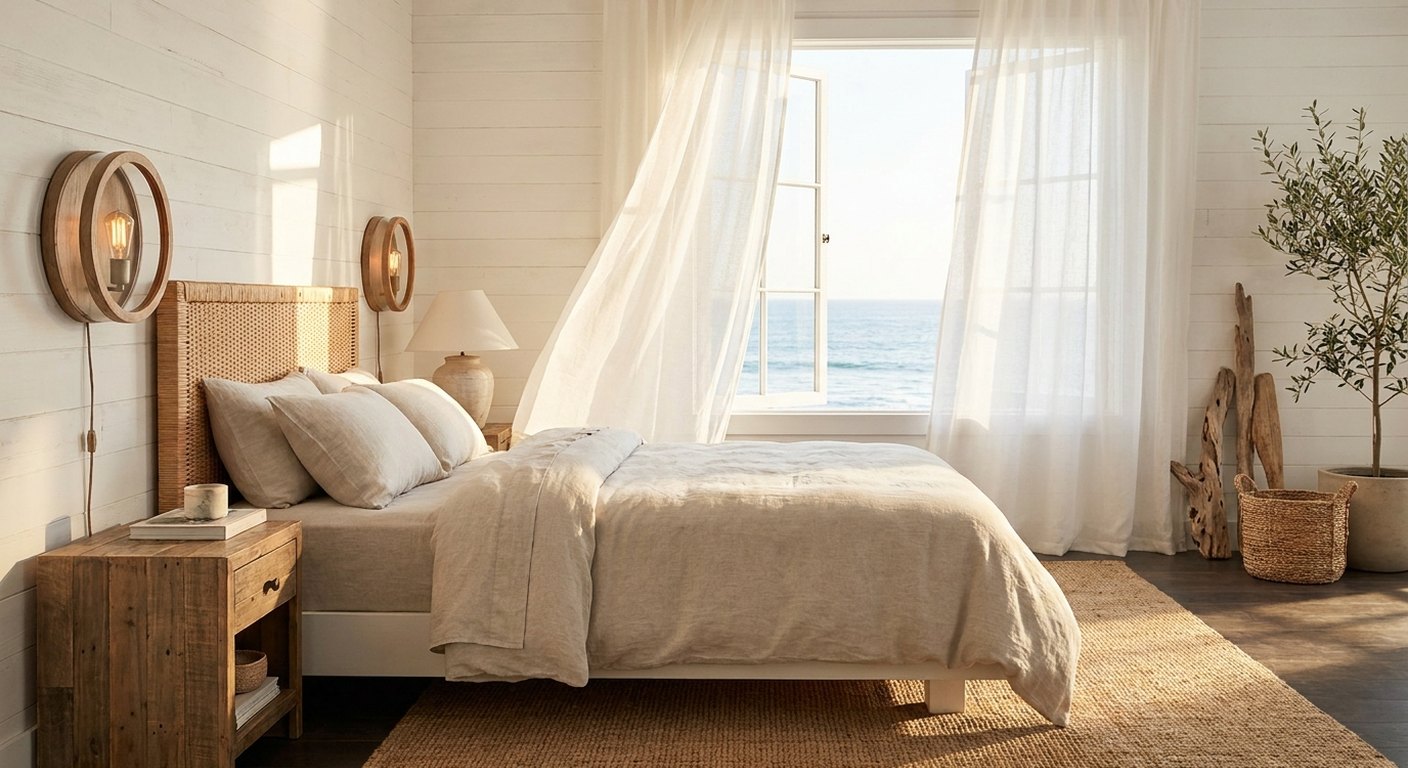
The two sconces flanking our fireplace are mounted at 66 inches to the center of the backplate, spaced about 40 inches apart so they frame the mantel without crowding it. That 66-inch height is roughly eye level for a standing adult, which is exactly where you want the warm glow in the evening, high enough to wash the wall, low enough to feel like lamplight rather than a spotlight. If you're flanking a piece of art or a mirror instead of a fireplace, keep the sconces symmetrical around the centerline of that object and leave 6 to 10 inches of breathing room on each side.
If your living room has no junction boxes beside the fireplace, most don't. This is exactly where a plug-in sconce earns its keep. Mount the plug-in version, run the cord down inside a paintable cord cover, and tuck the plug behind the nearest console or bookshelf. From across the room it's indistinguishable from a hardwired fixture, and you've added the single most flattering layer of light in the room without an electrician.
The Floor and Table Lamp Layer
Overhead light and sconces handle the architecture of the room; lamps handle the comfort. I keep one floor lamp in the corner the ceiling fixture can't reach and a low table lamp on the console behind the sofa. Together with the pendant and the two sconces, that's five separate light sources in one room, which sounds like a lot until you realize they're almost never all on at once. Morning is mostly daylight and the floor lamp; evening is the sconces and the table lamp with the pendant dimmed low. The point of layering isn't more light, it's more choices.
Color Temperature and Dimmers Do the Heavy Lifting
Every bulb in this room is a warm 2700K, and every fixture that can take one is on a dimmer. Warm light is the difference between a coastal living room that glows and one that feels like a waiting area, and the U.S. Department of Energy's ENERGY STAR bulb guidance is a good plain-English primer if you want to understand the lumen and Kelvin numbers on the box before you buy. Match the temperature across every source in the room, a single cool bulb among warm ones reads as a mistake even when you can't name why.
Textures That Read Coastal Without a Theme
The light sets the mood, but texture is what makes a pale room feel like the coast rather than a blank box. I keep to a small, repeated palette: linen on the upholstery, rattan in one or two pieces, jute underfoot, a little aged wood. And ceramic or stoneware in the accessories. Five natural materials, repeated, is plenty. The restraint is what keeps it from tipping into a nautical gift shop, no anchors, no rope, no seashells, just the honest materials a breezy coastal home is actually built from.
What I'd Do Differently
If I were starting this room again, I'd run the sconces on a smart switch from day one so they come on automatically at dusk. I added that later and wished I'd done it first. I'd also buy the pendant a size up from my initial instinct; the one I almost ordered would have been two inches too small and lost in the room. When in doubt with a coastal living room, size the light up and warm the bulb down. That's the whole formula.
What This Lighting Plan Cost
A layered, designed-looking living room costs far less than people assume. The opal glass pendant was the splurge at a little over a hundred dollars; the pair of plug-in sconces came in under that for both; the floor lamp and console lamp were thrifted and rewired. Add a dimmer and a box of warm high-CRI bulbs and the whole scheme, five sources, three moods, came together for less than a single statement chandelier. The expensive-looking part is the layering and the warm light, not the price tags.
The Mistakes I See Most Often
Three things turn a coastal living room cold. Relying on one overhead fixture flattens the room and kills the texture. A pendant that's too small floats near the ceiling with nothing to anchor. And the wrong bulb, a cool-white in a beautiful fixture, makes whitewashed walls read grey and linen look grey-blue. Fix those three and the room is most of the way there before you buy anything new.
Adapting It to Your Own Room
The exact fixtures matter less than the structure: one soft overhead, two sconces at eye level, and a lamp or two in the corners the ceiling can't reach. A darker, north-facing room leans harder on lamps; a sun-flooded one is really designed for the evening. Keep the bulbs warm and consistent and put the main fixture on a dimmer. That part travels to any space.
🌿 My one rule for coastal rooms: every light should feel like late-afternoon sun. Warm bulbs, soft shades, nothing harsh.
Shop this post: pendant lights and wall sconces for the living room