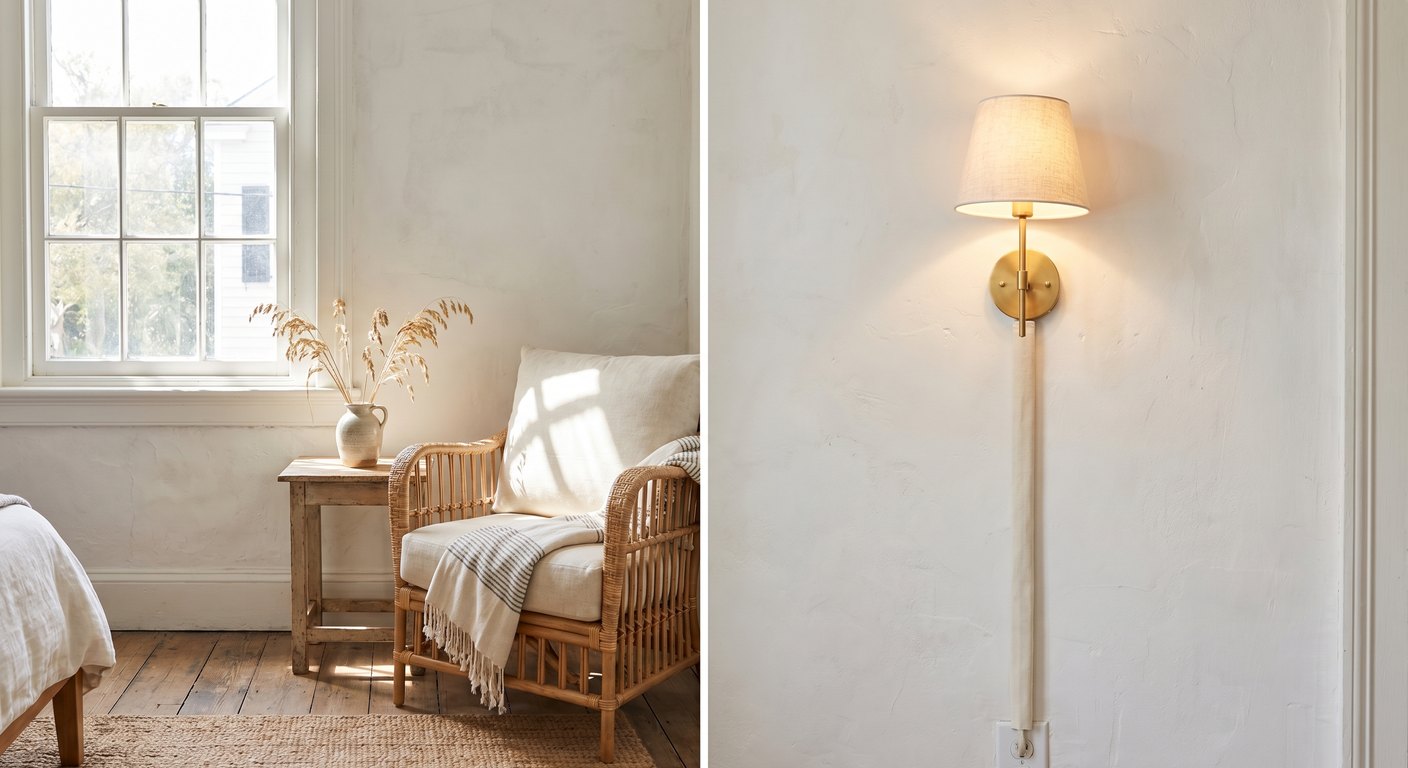
Our house was built in the 1920s, and rewiring it for sconces in every spot I wanted them would have cost a fortune and meant opening up plaster walls. Plug-in sconces solved the whole problem. Done right, they look hardwired. And they're perfect for renters and old houses alike.
The Look Without the Wiring
Plug-in sconces mount to the wall exactly like hardwired ones. The only difference is a cord running to an outlet. And that cord is easy to make nearly invisible.
Mounting
Mark your height (I use 60 inches for bedside, 66 for living spaces), level it, drill a pilot hole, add a drywall anchor if you're not in a stud. And screw on the bracket. Hang the sconce. Five minutes of work.
Hiding the Cord
This is the whole trick. Run the cord straight down to the baseboard inside a paintable cord cover, then horizontally to the outlet, never diagonally. Paint the cover to match the wall. From a few feet away, the sconce looks built-in. A diagonal cord is the only thing that gives the game away, so keep it vertical-then-horizontal.
The Cord Cover Is the Whole Trick
Everything about whether a plug-in sconce reads as hardwired comes down to the cord, and the cord cover is what sells the illusion. A cord cover, also called a raceway, is a slim channel that snaps over the wire and mounts flat to the wall, then paints to match. Run the cord straight down from the sconce to the baseboard and then horizontally to the outlet, never diagonally; the straight vertical-then-horizontal path disappears once painted, while a diagonal run draws the eye and looks unfinished. Furniture in front of the outlet hides the final stretch. Get this one detail right and a plug-in sconce is indistinguishable from a wired one at conversational distance.
Mounting in Plaster and Old Walls
Older homes like our 1920s house often have plaster walls, which spook people but are very manageable. Use the right anchors, a self-drilling plaster anchor or a toggle for heavier fixtures. And drill slowly to avoid cracking the surface. For lighter sconces, a stud or a quality drywall/plaster anchor holds fine. The beauty of plug-in over hardwired here is that you're making one small mounting hole, not opening up a century-old plaster wall to fish wire.
Giving Them Switch Control
The one thing a plug-in sconce lacks, a wall switch, is solved with a smart plug. Plug the sconce in, and control it by app, voice, or schedule; add a stick-on smart button on the wall for a true switch feel. I run a pair of bedside sconces on a smart plug set to come on at dusk and off at lights-out, and it behaves exactly like built-in lighting with none of the wiring.
What to Look For When Buying
When choosing a plug-in sconce, check three things: that it's a plug-in model with an attached cord (not a hardwired fixture you'd have to convert), that the cord exits in a spot that suits your wall and outlet. And that the style and finish lean soft and natural for a coastal room. A cord cover and the right anchors are a few dollars at any hardware store, so the fixture is nearly the whole cost.
What You'll Spend
The beauty of plug-in sconces is how little they cost to install: the fixture is nearly the whole expense, with a cord cover and anchors adding only a few dollars at any hardware store. No electrician, no permits, no opening walls. For renters and old-house owners, that's the difference between living with bad light and fixing it. The barrier to good wall lighting basically disappears.
Mistakes That Give Away a Plug-In
A plug-in sconce only looks hardwired if the cord is handled right. The tell-tale mistakes: a bare cord dangling down the wall, a cord run diagonally to the outlet, or a cover left unpainted. Run the cord straight down to the baseboard, across to the outlet, inside a cover painted to match. And tuck the plug behind furniture. Done right, it's invisible at conversational distance.
Where Plug-Ins Beat Hardwired
Beyond rentals, plug-ins win anywhere rewiring is impractical: plaster-walled old houses, spots with no nearby junction box, and arrangements you might want to change later. A pair of bedside sconces you can move to the next house, or relocate when you rearrange the bed, is a real advantage hardwired fixtures can't offer.
Where They Shine
Beside the bed, flanking a mirror, along a hallway, beside a reading chair, all the same spots I'd put a hardwired sconce. And on a smart plug, they even get switch-like control. For old houses and rentals, there's simply no better way to get sconce light.
Shop this post: plug-in wall sconces and bedroom wall sconces