Haint blue is the pale blue-green you see on porch ceilings all over Charleston, and it started with the Gullah Geechee people of the Lowcountry, who painted it around doors and windows to keep restless spirits, the "haints," from crossing in. Ours went up in March. I'd walked under these ceilings for eleven years before I painted my own, and I still got the color wrong the first time. So this is the post I wish I'd read before I bought paint.
Short version if you're standing in the paint aisle: pick something paler than you think, with more green in it than you think, and then go home and change your porch bulbs to 2700K before you judge it. The ceiling and the light are one decision, not two.
What color is haint blue, exactly?
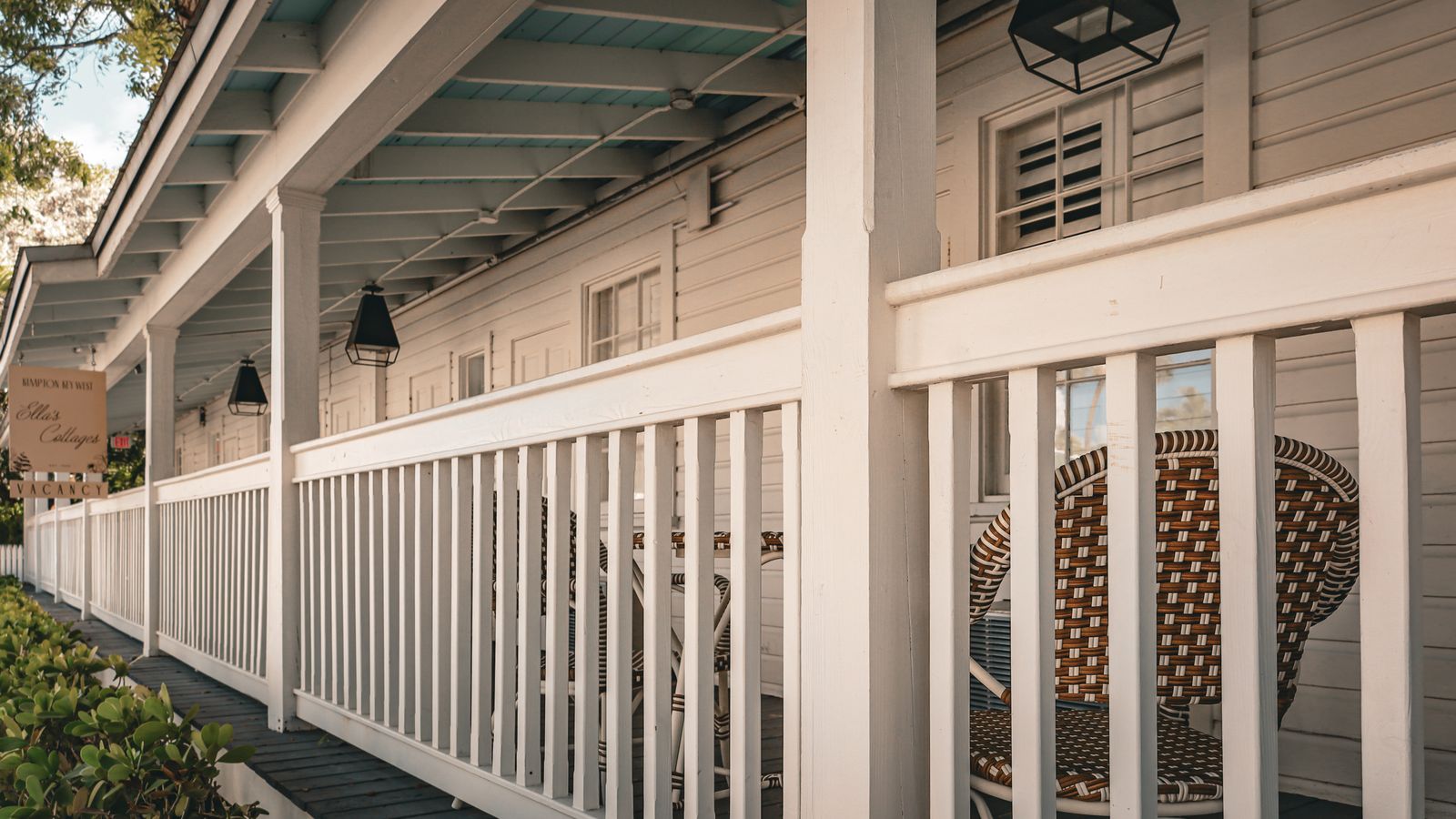
Haint blue isn't one color. It's a family of soft blues that lean green, somewhere between a robin's egg and the water in a shallow tidal creek at noon. The old versions were mixed by hand from lime, milk, and indigo, and indigo was a Lowcountry cash crop in the 1700s, so the pigment was right there. Because the mix was never standardized, no two porches matched. That's still the charm. Walk down Tradd Street and you'll count six different blues in a block.
The traditional range runs pale. If you hold a chip against the sky on a hazy August afternoon and the chip is darker than the sky, it's too dark. I mean that literally. I did that test with the first can I bought and the chip won, and the ceiling ended up looking like a swimming pool. More on that below.
Modern paint lines have their own takes. Benjamin Moore's Palladian Blue (HC-144) is probably the most-used one in Charleston right now. Sherwin-Williams Rainwashed (SW 6211) is a little greener and a little grayer. Both are fine. Neither is "the" haint blue, because there isn't one.
Why are porch ceilings painted blue in the South?
Two reasons, and the honest answer is that the second one grew out of the first. The original reason is spiritual. In Gullah Geechee tradition, spirits can't cross water, so painting the color of water on the thresholds of a house, the ceilings, door frames, and window trim, kept them out. Porch ceilings are the biggest threshold there is. The word "haint" is a Lowcountry form of "haunt."
The second reason is the one people repeat at dinner parties: it keeps the bugs away. The idea is that wasps and mud daubers read the blue as sky and won't build nests there, and that mosquitoes are fooled the same way. I've seen this stated as fact in a dozen articles. I've also seen it debunked in a dozen more. My own porch ceiling, after one summer, has one small mud dauber nest in the corner by the downspout. So take that for what it's worth. The more likely explanation is that the old milk paint had lime in it, and lime is a mild insect repellent, so the paint really did keep bugs off, and the color got the credit.
I'll say this, though. Whatever the bugs think, the blue makes people slow down on the porch. That part I'd defend in court.
The part nobody tells you: a blue ceiling changes your light
This is the thing I'd actually like you to take from this post, because I haven't seen it written anywhere. A blue ceiling turns your porch light cooler. Not a little. A lot.
Here's what happens. Most porch light comes from a fixture on the wall or the ceiling, and a big share of it bounces off the ceiling before it reaches your face. A white ceiling bounces the light back the same color it arrived. A blue-green ceiling absorbs some of the red and yellow and sends back mostly the blue. So a bulb that looked warm and welcoming under your old white ceiling suddenly looks like a hospital corridor under the new blue one. Same bulb. Same fixture. Different ceiling.
I found this out the night we finished painting. We'd had 3000K bulbs in the porch sconces for years and never thought about them. That evening I walked out with a glass of wine, looked up, and the porch was the color of skim milk. My husband said it looked like a gas station. He was right.
The fix was cheap. I swapped the two sconce bulbs to 2700K, which is the warm end of what you can easily buy, and it pulled the light back to where it belonged. Then I went further. I put a 2200K "amber" bulb in the ceiling lantern nearest the door, the kind sold as a vintage-look filament bulb. Under a white ceiling that would look orange. Under haint blue it looks like candlelight. That's the combination I'd recommend to anyone: 2700K in wall sconces, 2200K in anything that shines straight up at the blue.
Rule I wish I'd known: under a haint blue ceiling, go one step warmer on every bulb than you'd choose for a white ceiling. 3000K becomes 2700K. 2700K becomes 2200K.
Which shade did I choose, and what went wrong first
I'll tell you both, because the mistake is more useful than the win.
First try: Sherwin-Williams Tradewind (SW 6218). It's a lovely color on the chip and in a lot of photos. On our ceiling, in full afternoon sun off the harbor, it read as a proper mid-tone blue. Pool blue. It fought the white clapboard and it made the porch feel smaller and shadier than it is, because a darker ceiling always drops the visual height of a space. We lived with it for two weeks. I kept telling myself it would grow on me. It didn't.
Second try: Benjamin Moore Palladian Blue, cut 25 percent with the same brand's white. That is, three parts Palladian Blue to one part white. The paint counter will do this for you if you ask nicely and bring the exact numbers. The result is barely blue at all when you look straight at it in the middle of the day. Then the sun drops and the ceiling picks up the last light and glows green-blue for about forty minutes. That forty minutes is the whole reason to do this.
Cost, since people ask: one gallon of the Tradewind I didn't use, $74. One gallon of the Palladian mix, $82. A quart of primer because the old ceiling was oil-based, $28. Two afternoons of my husband's time on a ladder, which he has asked me to value at "a lot." Call the whole thing $184 plus the wasted gallon, and about $110 if you get it right the first time.
Does haint blue work on a modern house?
Yes, and it works better than most "historic" details do, because it's a color rather than a form. You don't need turned balusters or a tin roof. A 1990s ranch with a flat concrete stoop can have a haint blue ceiling and it looks intentional, not costumey. A friend in Mount Pleasant did hers on a brick 1980s two-story last spring and the only comment she gets is "why does your porch feel so nice?"
The place it doesn't work is under a ceiling that's already a strong color. Blue on a dark-stained wood ceiling is muddy. If you have beadboard stained walnut, leave it. If you have beadboard painted white, or a plain plaster or drywall ceiling, you're the ideal candidate.
One more caution. If your house is a cool gray or a cool white, a greener haint blue can push the whole facade toward chilly. Go for a blue with a touch more warmth in that case, something like Sherwin-Williams Sea Salt, which has a little yellow hidden in it. Our house is a warm off-white, so we could go greener without it going cold.
How to paint a porch ceiling blue without ruining your weekend
Prep is nine-tenths of this. Old porch ceilings in Charleston are usually beadboard with a hundred years of oil paint on them, and new latex won't stick to old oil without a bonding primer. We skipped the primer on a test patch to see what would happen. It peeled in a sheet within a month. Don't skip it.
The sequence that worked for us: wash the ceiling with a mild detergent and a sponge on a pole, let it dry a full day, spot-scrape anything loose, one coat of bonding primer, two coats of exterior satin. Satin, not flat and not gloss. Flat shows every roller mark in the raking evening light. Gloss bounces too much and makes the bulb-color problem worse. Satin is the quiet middle.
Use a 3/8-inch nap roller for beadboard. A thicker nap loads too much paint into the grooves and drips. Cut in the edges with a two-and-a-half-inch angled brush. Wear a hat. Paint falls in your hair no matter what.
Do the ceiling before you do the porch floor if you're doing both. We did them the other way round and spent an afternoon wiping blue drips off gray floorboards.
Styling a porch under a haint blue ceiling
The ceiling is the one strong color, so everything else can relax. This is where the whole coastal grandmother thing really lands, because the porch is the room where you're allowed to look like you've had the same chairs for thirty years.
Ours has two wicker chairs with washed-linen cushions in a color the fabric shop called "oatmeal," a low teak table that has never been oiled and has gone silver, and a jute rug that I replace every two summers because Charleston humidity eventually wins. The sconces are simple black lanterns with clear glass. I resisted the urge to buy the ones with seeded glass, because seeded glass scatters light and under a blue ceiling scattered light looks foggy. Clear glass, warm bulb, done.
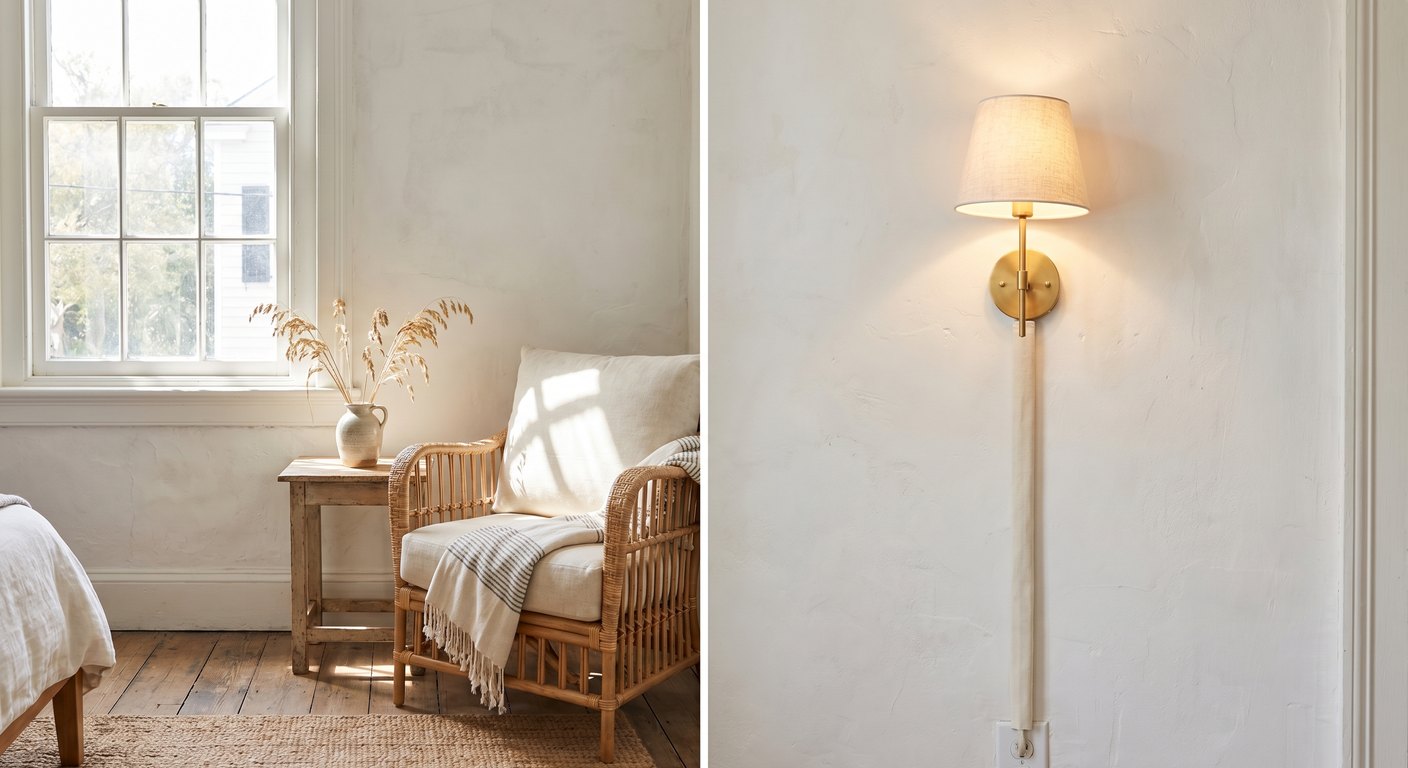
I'd skip the string lights. I know they're everywhere. Under haint blue they read as a restaurant patio, and the point of this ceiling is that it looks like it's been there since before your grandmother was born. A pair of wall sconces at about five and a half feet, plus one ceiling lantern, is plenty. If you want a third layer, a small plug-in lamp on the side table with a linen shade gives you reading light and makes the porch feel like an actual room after dark. I wrote about plug-in sconces for old houses if your porch has no wiring at all.
Plants: ferns, obviously. Boston ferns in old clay pots hung from the ceiling, three of them, evenly spaced. The green of the fern and the green in the blue talk to each other. If you have the wrong blue, the ferns will show you. That's actually how I finally admitted the Tradewind was too dark. The ferns looked wrong against it.
Is haint blue only for Charleston?
No. You'll find it up and down the coast from Savannah to Wilmington, across the Gulf into New Orleans, and by now in plenty of places with no water for a hundred miles. It travelled with the people. The tradition is Gullah Geechee and it deserves to be named as such when you write about it, but a blue porch ceiling in Ohio is not stealing anything. It's a good idea that spread.
What is particular to Charleston is the light. We get a soft, humid, silvery light most of the year, and the pale blue-green ceilings were mixed to suit it. If you live somewhere with hard, bright, dry light, like Phoenix or Denver, you may find the very pale versions wash out to white. Go one shade deeper in that case. If you live somewhere gray, like Seattle, the greener versions can look sad in winter. Lean bluer.
The evening test
Here's how I'd choose, if I were doing it again from scratch. Buy three sample pots. Paint three foot-square patches on the ceiling, spaced apart, not next to each other. Live with them for a week. Look at them at seven in the morning, at noon, and, most importantly, at dusk with the porch lights on and your actual bulbs in the fixtures. The dusk test is the one that matters, because that's when you'll be sitting out there.
The right one will be the patch you stop noticing. Not the prettiest chip. The one that makes the porch feel like it's always been that way.
Ours has been up six months now. The mud dauber has a nest. The ferns are thriving. And every evening around eight, for about forty minutes, the ceiling turns the color of the creek and I forget whatever I was worried about. That's the whole point of a porch, and it turns out a quart of blue paint and the right bulb is most of what it takes to get there. If you're rethinking the rest of your porch lighting while you're at it, the porch and entry post covers the fixtures, and why warm light matters covers the bulbs in more depth than I've gone into here.
Shop this post: wall sconces and plug-in wall sconces for porches with no wiring