The entry is the handshake of a house. It's the first breath someone takes inside and the last impression they carry out. Ours was a narrow foyer with a dated flush mount and nowhere to put keys, not exactly the warm Charleston welcome I wanted. Here's how I fixed it.
A Pendant That Welcomes
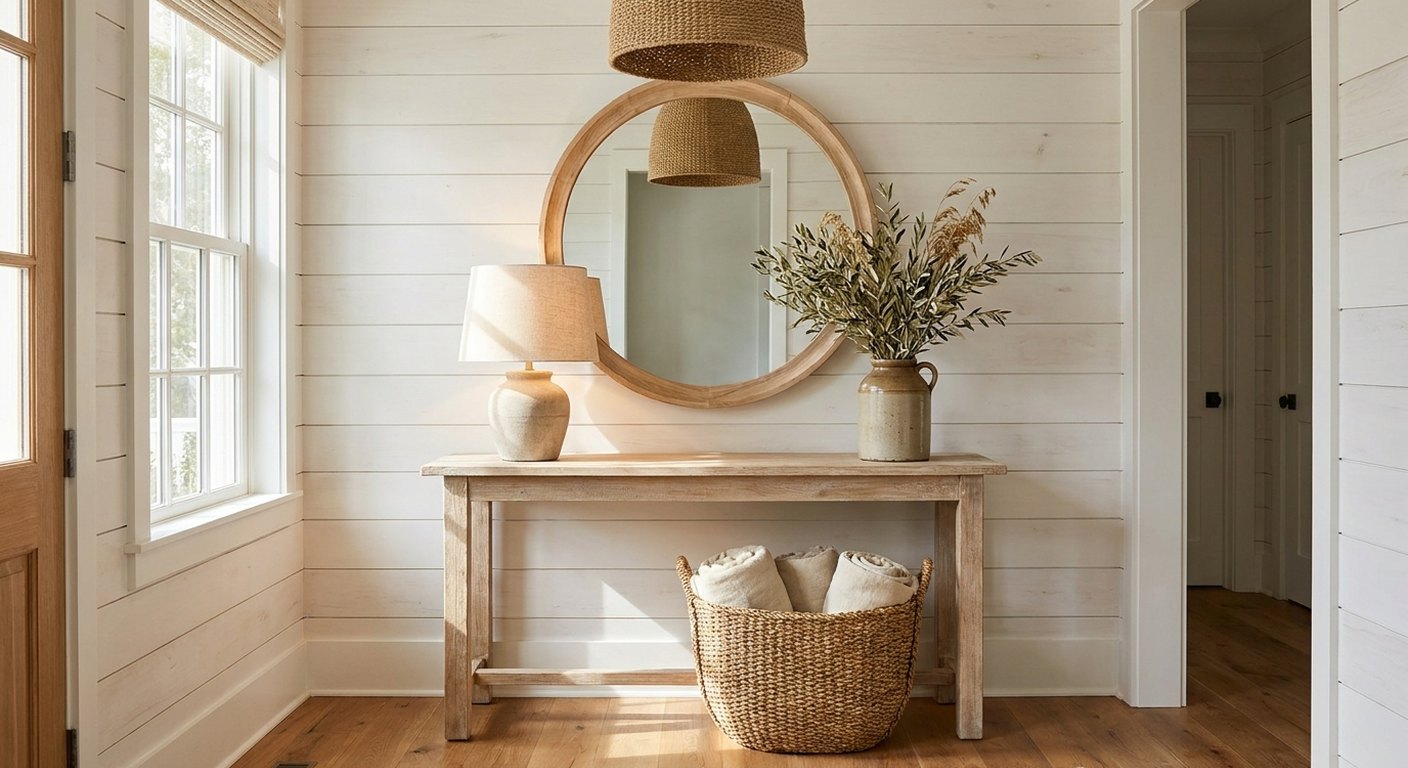
I swapped the flat ceiling fixture for a soft foyer pendant. Even in a small entry, a pendant draws the eye up and gives the space a sense of intention. The warm glow it casts the moment you open the door does more for the welcome than anything else in the room.
A Place to Land
A narrow console against the wall gives keys, mail, and sunglasses somewhere to live. A small lamp on it adds a second, lower glow at eye level, see the rest of the entryway fixtures I considered. Above it, a round mirror bounces the light and makes the narrow space feel wider.
Natural Texture at the Door
A woven basket for shoes, a jute runner, and a little stoneware vase that I keep filled with whatever's clipped from the yard. These natural touches signal the coastal feeling of the whole house from the very first step inside.
Choosing the Right Entry Fixture
The entry fixture sets the tone for the whole house, so it's worth getting the proportion right. In a standard-ceiling foyer, hang the bottom of the fixture at least seven feet off the floor so people pass under it comfortably; in a two-story entry, center it in the volume and let it hang lower to fill the space. For a narrow entry like ours, a compact foyer pendant or a flush-mounted lantern keeps the sightline clear while still drawing the eye up. If your entry is truly tight, a pair of wall sconces flanking the door or a mirror gives symmetry without taking ceiling space.
Material-wise, a soft glass or natural-woven shade reads coastal and welcoming, while a heavy dark fixture can feel closed-off at a front door. Keep it light, both literally and visually.
Give Everything a Place to Land
An entry feels calm when arriving home has a choreography: keys in the bowl, bag on the hook, mail in the tray. A narrow console gives all of that a home and adds a surface for a lamp, and a closed cabinet hides shoes so the floor stays clear. The system only works if it's effortless, so keep it simple, one bowl, a few hooks, one basket. You can see the range of entryway fixtures I weighed; the lamp on the console matters as much as the overhead, because eye-level light is what makes the space feel warm rather than merely lit.
Mirrors and the Illusion of Space
A mirror is the entryway's best trick. Hung opposite or beside the light source, it bounces daylight deeper into the space and visually doubles a narrow foyer. It's also useful, a last glance before you walk out the door. A round mirror softens the hard lines of a tight entry; a tall one exaggerates ceiling height. Either way, position it to catch and throw the light from your fixture.
Natural Texture at the Threshold
The entry is where you announce the coastal feeling of the whole home. And a few natural textures do it instantly: a woven basket for shoes, a jute runner underfoot, a stoneware vase with whatever's clipped from the yard. These small, warm, organic touches signal the aesthetic from the very first step inside, without a single literal beach motif. Restraint is the point, a calm, uncluttered threshold is more welcoming than a styled one.
What I'd Do Differently
I waited far too long to replace the original brass-ring fixture. It should have been the first light I changed, not one of the last, because it's the first and last thing anyone sees. I'd also have put the entry light on a dusk-to-dawn smart bulb from the start so it greets us automatically when we come home after dark.
What the Entry Update Cost
The entry came together for very little. The foyer pendant replaced a dated fixture in a straight swap, the console was a secondhand find, and a mirror, a small lamp, a basket, and a vase rounded it out. For the price of one nice piece of furniture, the first and last thing anyone sees in the house went from dated to welcoming. The best per-dollar return of any room, because everyone passes through it.
Common Entryway Mistakes
Entries go wrong when they have nowhere to put things, so clutter piles on every surface; when the only light is a harsh overhead that's jarring after dark; and when they're over-decorated instead of kept clear. Give every item a home, add a warm dimmable light and a console lamp at eye level, and keep the styling to a mirror, a vase, and a basket. Order and warmth, not decoration.
Small Entry vs. Two-Story Foyer
The approach scales both ways. In a tight entry like ours, a compact pendant or flanking sconces and a slim console keep the sightline clear. In a two-story foyer, a larger fixture centered in the volume fills the space and a fuller console anchors it. Either way the principles hold: warm light, a landing surface, a mirror to bounce light, and a touch of nature.
Warm and Dimmable
The pendant is on a dimmer with a warm bulb. In the evening it glows low and soft; when guests arrive I bring it up. That small flexibility is what makes an entry feel like a living part of the home rather than just a passage to somewhere better.
Shop this post: entryway light fixtures and foyer pendant lights