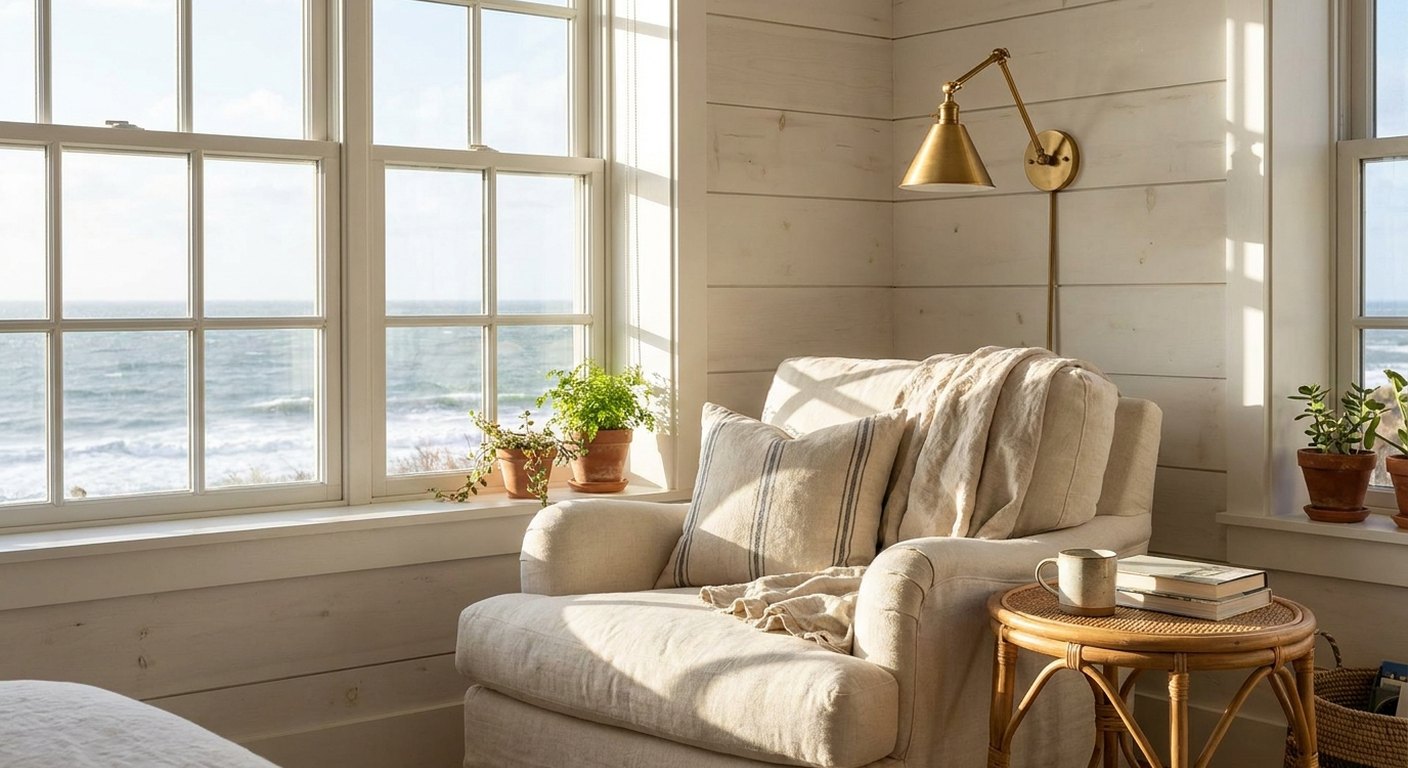
Every house should have one chair, by one window, with one perfect light. Ours sits in the corner of the living room where the afternoon sun lands, and it has quietly become my favorite square footage in the whole house.
The Chair and the Light
A deep, soft armchair angled toward the window does the daytime reading on its own. For evenings, I mounted an adjustable wall sconce just behind the chair at shoulder height. The arm swings out over the page, so the light falls exactly where I need it with no glare. No floor lamp, no cord across the rug.
Natural Texture, Naturally
A small rattan side table holds a cup and whatever I'm reading. A linen cushion and a soft throw make the chair a place you sink into. The textures are all warm and natural, in keeping with the rest of the coastal palette.
Positioning a Reading Light
The best reading light comes from just behind or beside your shoulder, angled onto the page. So it lights the book without glare on the page or in your eyes. An adjustable-arm wall sconce is ideal because you can swing it exactly where you need it and tuck it away when you don't. I mounted ours at about shoulder height when seated, roughly 48 to 52 inches from the floor beside the chair, with the arm reaching out over the page. That position keeps the light off the wall behind and on the words in front.
If you read in the evening, warmth matters as much as position: a 2700K bulb is easy on the eyes over long stretches and won't fight your wind-down at night. The wall sconce I chose has an adjustable head so the same fixture serves both an upright read and a slouched-into-the-cushions one.
The Anatomy of a Good Nook
A reading nook needs only three things: a comfortable chair, a good light, and a surface for a cup and a book. Everything beyond that is comfort, not necessity. Ours is a deep armchair angled toward the window for daytime light, a small rattan side table within arm's reach, and the sconce for evenings. A linen cushion and a soft throw make it a place you sink into. The coziness comes from the chair and the light, not the square footage, a corner is plenty.
Daylight by Day, Sconce by Night
The reason the nook sits by a window is that the best reading light for half the day is free. Position the chair to catch the daylight without putting the window directly behind the page, where it backlights the book and tires your eyes. Then let the sconce take over at dusk. Two light sources, each for its time of day, mean the chair is usable from morning coffee through the last chapter before bed.
Keeping It Coastal
The textures in the nook are all warm and natural, a rattan side table, a linen cushion, a soft throw, a stack of books. So the corner reads as part of the coastal whole rather than a separate utilitarian zone. A trailing plant on a nearby shelf or a small lamp elsewhere in the room ties it back into the larger space. The nook should feel like the calmest corner of an already calm room.
What I'd Do Differently
I'd have chosen the adjustable-arm sconce from the start instead of the fixed one I first hung. The ability to aim the light is what makes a reading nook actually work for reading rather than just looking the part. I'd also angle the chair a few degrees more toward the window; a small turn made a surprising difference to the afternoon light on the page.
What a Nook Costs to Build
A reading nook is almost free if you already have the chair. The adjustable wall sconce was the only real purchase; a thrifted rattan side table, a linen cushion, and a throw finished it. There's no need for new furniture. The point is to claim an existing corner by a window and give it good light. The whole project is an afternoon and the cost of one fixture.
Mistakes That Ruin a Reading Nook
A nook fails when the light is wrong: a fixture that glares on the page or in your eyes, or a floor lamp that eats the little floor space and tangles a cord across the rug. It also fails when the chair faces away from the window, losing the free daytime light. Aim a sconce from behind the shoulder, keep the floor clear, and angle the chair toward the window.
Nooks for Small Homes
You don't need a dedicated room, a nook is a corner with intention. The end of a hallway, a wide landing, a bay window, or the quiet corner of a living room all work. A wall-mounted sconce is what makes these tight spots viable, because it adds reading light without surrendering the floor. In a small home, the nook is a mindset more than square footage.
Why a Sconce Beats a Lamp Here
I considered a slim floor lamp or a small table lamp, but the corner is tight and a sconce keeps the floor clear and the side table free for a cup. Wall-mounted reading light is one of those small upgrades that feels disproportionately luxurious once you live with it.
Shop this post: wall sconces and table lamps for the living room