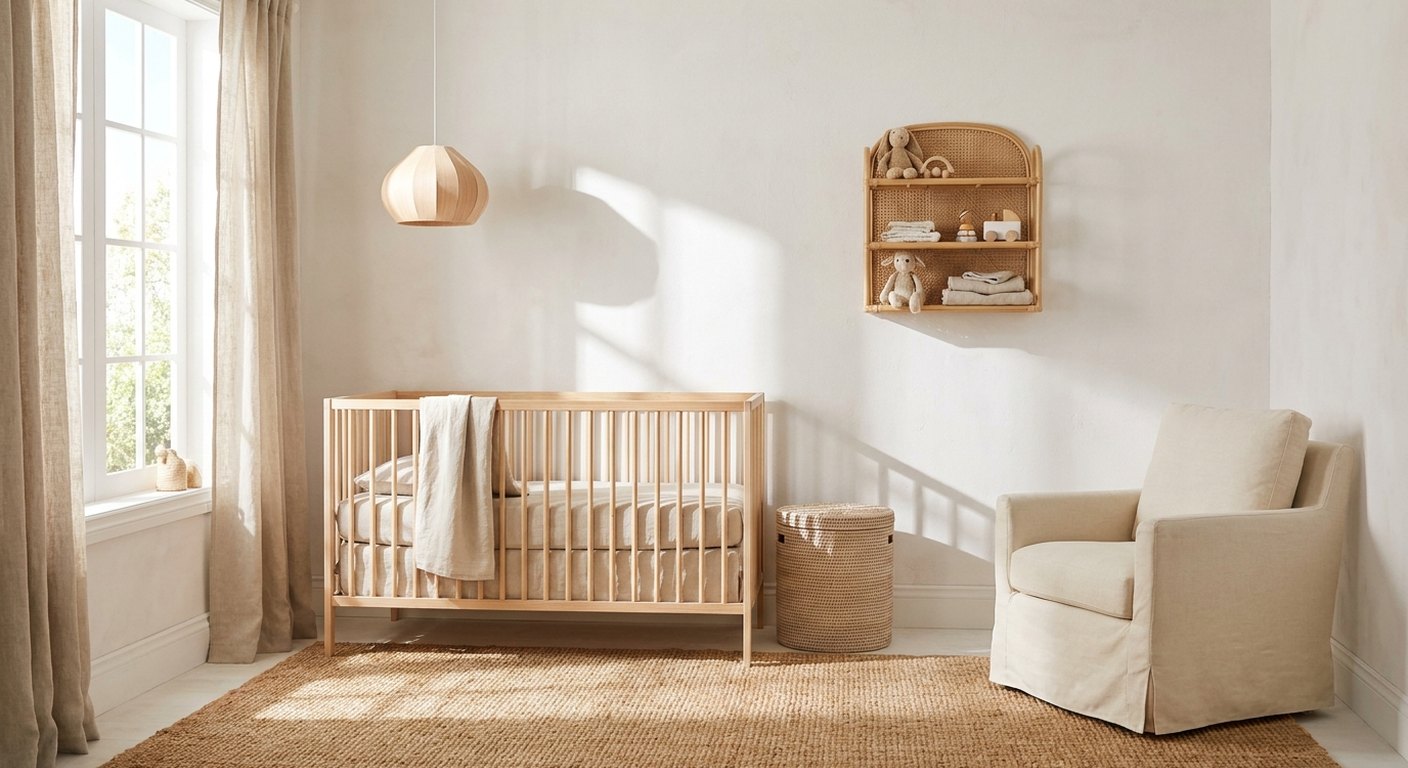
When we set up the nursery, I had one goal: make it as calm as the sleep we were hoping for. That meant the same coastal restraint as the rest of the house, soft whites, natural textures, and above all, warm, layered, dimmable light.
Soft Whites and Naturals
The walls are a warm white, the crib is natural wood, and the textures are gentle, a jute rug, a rattan basket for blankets, washed cotton everywhere. Nothing loud, nothing overstimulating. A calm room for a small person figuring out the world.
A Gentle Pendant Overhead
For the main light I hung a soft wood hanging light, the Kida wood pendant. The natural material keeps it warm and organic, and on a dimmer it goes from playtime-bright to barely-there.
Light for the 3 a.m. Shift
The most important light in a nursery is the one you use at night. A small, warm, low-output source near the chair lets me feed and change without flooding the room and waking everyone fully. Dim and amber, it keeps those midnight hours gentle.
Why a Dimmer Is the Most Important Thing in a Nursery
If a nursery gets only one upgrade, make it a dimmer on the main light. A nursery has to be two opposite rooms in the same day, bright and cheerful for play and diaper changes, then dim and calm for feedings and bedtime. And a dimmer is what lets one fixture do both. Paired with a warm 2700K bulb, the low setting glows soft and amber, which is exactly the gentle light you want for a sleepy baby and a sleepier parent. The hanging light I chose dims smoothly down to a near-candle glow, which has been worth its weight at 3 a.m.
I went with the Kida wood pendant for the main fixture because the natural material keeps it warm and organic rather than clinical, and the soft shade diffuses the light evenly across the room.
Light for the Night Shift
The most-used light in any nursery is the one you reach for at night, and it should be low, warm, and separate from the bright overhead. A small lamp or a dimmable sconce near the feeding chair lets you tend to the baby without flooding the room and fully waking either of you. Keeping that light warm matters for more than mood: cooler, bluer light in the small hours is more disruptive to sleep, which the Sleep Foundation notes in its guidance on light and the bedroom. Warm and dim is the whole brief for the night shift.
A Calm Palette for a Small Person
The same coastal restraint that calms an adult's bedroom calms a nursery. Soft whites, natural wood, gentle textures, a jute rug, a rattan basket, washed cotton, keep the room soothing rather than overstimulating. Bold color and busy pattern are easy to overdo in a nursery; I keep them to small, swappable accents and let the calm neutral base carry the room. A baby figuring out the world doesn't need a loud one to look at.
Safety With Natural Materials
Coastal-natural and baby-safe aren't in conflict, but a few choices matter: keep cords from lamps and monitors well out of reach, anchor any tall furniture to the wall. And place the crib away from windows, cords, and the direct line of the overhead light. A wall-mounted or ceiling fixture keeps light sources up and out of reach, which is one more quiet argument for a pendant over a table lamp in a nursery.
What I'd Do Differently
I'd have installed the dimmer before the baby arrived rather than fumbling to add it in the first sleep-deprived weeks. And I'd have committed to the warm night-light setup from day one. The difference between a cool overhead and a low amber glow at 3 a.m. is the difference between a baby who settles back down and one who decides the day has started.
What the Nursery Cost
We kept it modest. The natural-wood crib and a soft wood pendant were the anchors; a jute rug, a rattan basket, and washed cotton filled it out affordably, and a dimmer was a few dollars well spent. Because the palette is neutral and the bold touches are small and swappable, the room won't need an expensive redo as the baby grows. The foundation stays and the accents change.
Common Nursery-Lighting Mistakes
The usual errors: a single bright, cool overhead that's harsh for both baby and parent; no low night-light source. So every wake-up means flooding the room; and no dimmer, leaving only one setting. Warm 2700K bulbs, a dedicated low light by the feeding chair, and a dimmer on the main fixture solve all three and make the room work across a baby's whole day and night.
Lighting That Grows With the Child
The same fixtures carry from newborn to toddler to child with only the settings changing. The dimmable pendant goes from a low feeding glow to bright playtime light; the night source becomes a reassuring glow for a child afraid of the dark. Choosing calm, neutral, well-made lighting up front means you light the room once and adjust rather than replace as the years pass.
Room to Grow
Because the base is so neutral, the room can evolve. The bold touches are all small and swappable, a print, a cushion, a mobile. The calm coastal foundation stays, no matter how the little details change over the years.
Shop this post: hanging lights for the bedroom and the Kida wood hanging light