If coastal grandmother style has a natural home, it's the dining room. This is where the aesthetic gets to be its warmest and most collected, natural materials, soft linens, a table that's seen a few holidays. And light that makes everyone look good and feel like staying. Here's how I put ours together.
The Pendant Sets the Tone
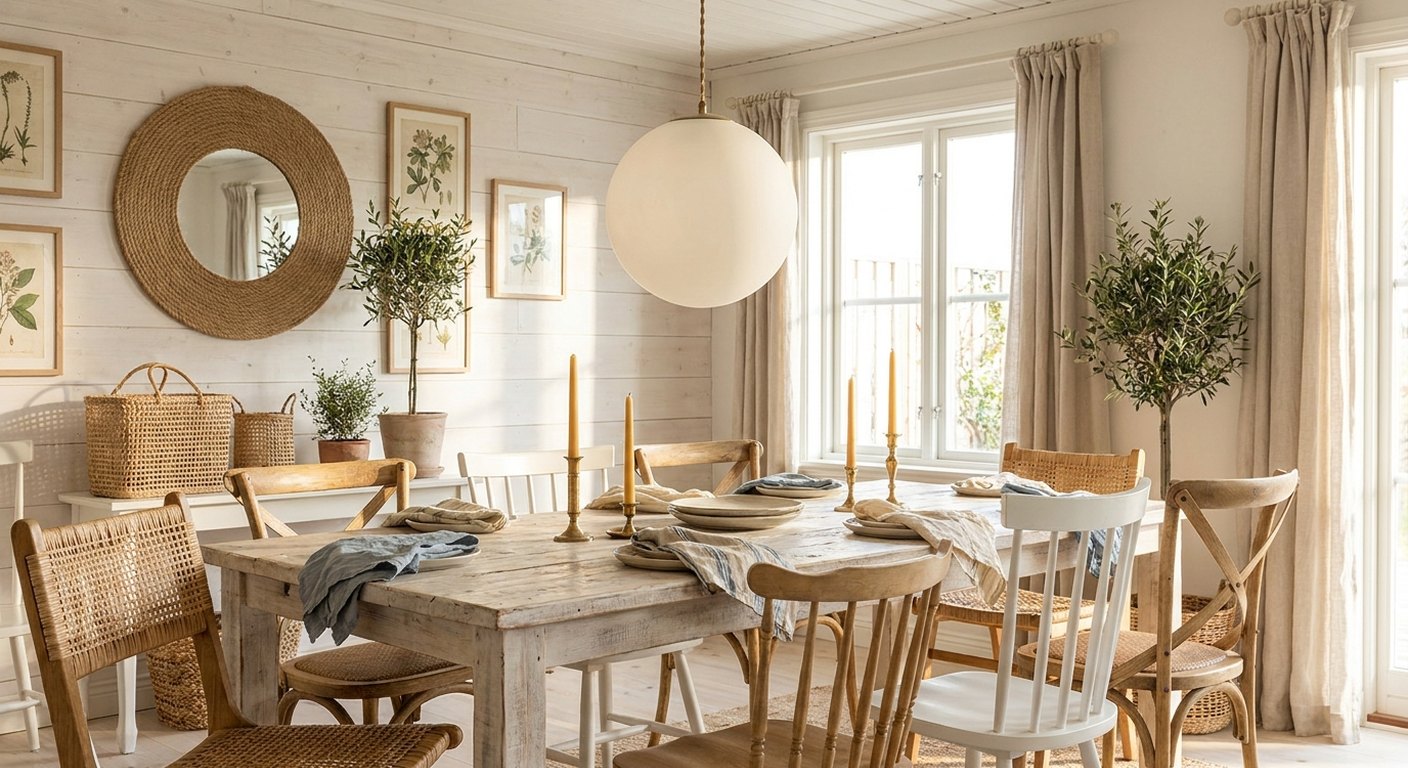
Over the table I hung a soft glass pendant with an opal globe. It glows rather than glares, and the simple Nordic shape keeps the room from tipping into fussy. Centered over the table at 32 inches above the surface, it anchors the whole room.
Collected, Not Matched
The chairs don't match. Two are spindle-back finds, two are cane, and they get along beautifully because they share a warm wood tone. Coastal grandmother style is about looking gathered over time, not bought in one go. A perfectly matched set would feel too showroom.
Layer in a Second Light
A small lamp on the sideboard adds a second, lower glow. For bigger gatherings I'd add a pair of sconces, see all my dining room lighting ideas. But even one extra warm source transforms the evening mood. Overhead light alone is for tasks; layered light is for lingering.
Hanging the Pendant at the Right Height
Over a dining table, the fixture can hang lower than anywhere else in the house because no one walks under it. And that low, intimate light is exactly what makes dinners feel special. Aim for the bottom of the pendant 30 to 34 inches above the tabletop; I settled on 32. Lower pools the light warmly on the table and faces; higher starts to feel like general room lighting and loses the intimacy. Center it over the table, not the room, and if your table is pushed to one side, the fixture follows the table.
Scale matters just as much as height. A dining fixture should be roughly half to two-thirds the width of the table, for our table that meant a globe in the 20-to-24-inch range. Undersized dining pendants are the most common mistake in the room and the easiest to avoid: when you're between two sizes, size up.
Why Mismatched Chairs Work
The collected, gathered-over-time look at the heart of coastal grandmother style lives or dies on the seating, and mismatched chairs are the secret. Ours are two spindle-backs and two cane chairs, unified by a shared warm wood tone rather than a matching silhouette. The trick is one common thread, a finish, a material, a tone. So the variety reads as hand-picked rather than chaotic. A perfectly matched dining set, by contrast, always feels a little showroom, a little bought-in-one-trip.
Layering Light Beyond the Pendant
One pendant lights the table; a warm, inviting room needs a second source. A small lamp on the sideboard adds a low glow at the edge of the room. And for larger gatherings a pair of wall sconces flanking a mirror or a piece of art doubles the warmth at eye level. You can see the range of fixtures I considered in the dining room lighting collection. The principle is the same as everywhere else in a coastal home: never let a single overhead source do all the work.
The Dimmer Is Non-Negotiable
If you put one fixture in the house on a dimmer, make it the dining room pendant. A bright overhead is for homework and folding laundry; a dimmed one is for lingering over a long meal. Dropping the pendant low in the evening also makes a warm bulb glow even warmer and more golden. And there's good evidence that softer, warmer evening light is gentler on the body's wind-down, as the Sleep Foundation notes about light and the evening. A dimmer and a 2700K bulb turn one fixture into every mood a dining room needs.
What I'd Do Differently
I'd have bought the larger pendant the first time instead of returning an undersized one, and I'd have added the sideboard lamp on day one. The room felt flat until that second, lower light source went in. The lesson I keep relearning in a dining room: the table makes the meal, but the light makes the evening.
Building the Room on a Budget
A collected dining room is the easiest room to do cheaply, because mismatched and thrifted is the look. The glass pendant was the one real purchase; the chairs were gathered secondhand and unified by tone, the table was already ours, and linen napkins and taper candles cost almost nothing. The gathered-over-time feeling can't be bought in one trip anyway, so a tight budget and patience actually serve the aesthetic.
Common Dining-Light Mistakes
The big three: a fixture hung too high, so it reads as general room light instead of an intimate pool over the table; a fixture too small for the table, looking lost; and no dimmer. So the only setting is bright-overhead. Hang it 30-34 inches above the table, size it to half or two-thirds the table width, and put it on a dimmer. That's the whole formula for a room made for lingering.
Lighting for Gatherings vs. Everyday
The room flexes between a quiet Tuesday dinner and a full table of guests. Everyday, the dimmed pendant and a sideboard lamp are plenty; for gatherings I bring up a second lower source and light the candles so faces glow from more than one direction. The dining fixtures I considered all shared one trait. They look as good dimmed low as bright, which is what a dining room actually needs.
Linen and Candlelight
Washed linen napkins, a couple of taper candles, a low bowl of whatever's blooming. With the pendant dimmed and the candles lit, the room does exactly what a coastal grandmother dining room should. It makes a Tuesday dinner feel like an occasion.
Shop this post: dining room lighting ideas and glass pendant lights