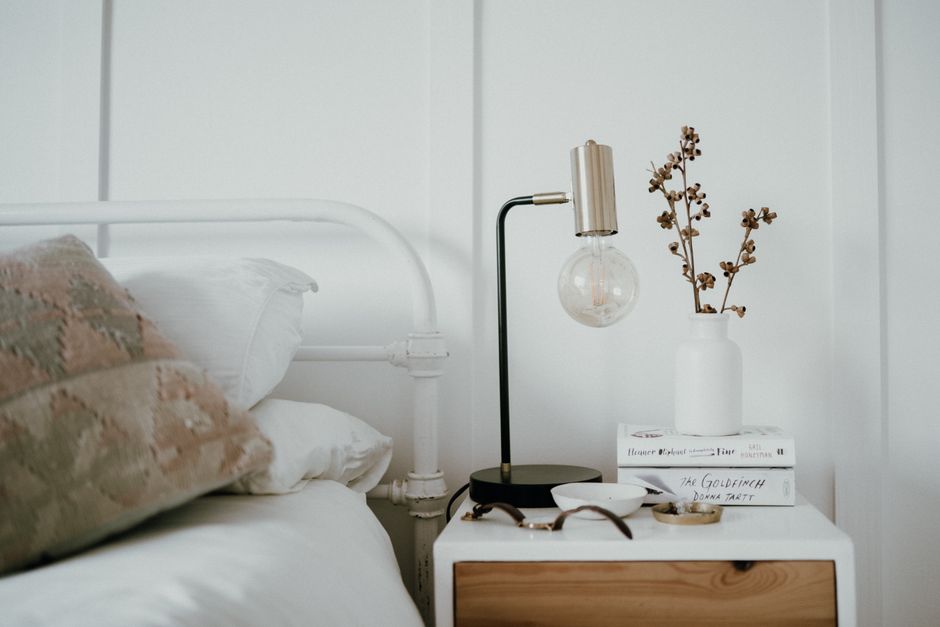
I've had four different bedside reading lamps in this house, which tells you something about how long it took me to get it right. The first was a tall table lamp that ate most of the nightstand surface. The second was a clip lamp I ordered from a catalog that vibrated loose from the headboard every time I turned the page. The third was a rechargeable cordless lamp I loved until it needed charging every three days and I started resenting it. The fourth is what I have now, and I think I'll keep it.
The right bedside reading lamp is one of those details that sounds simple and turns out to involve a surprising number of decisions. Here's how I think about them now.
Height Is the Variable That Matters Most
The light needs to hit the page, not the ceiling and not your partner's face. For most people reading in bed with a standard frame and mattress, the optimal position for the bulb is 20 to 24 inches above the mattress surface. That's where the light angles down onto a book without casting shadows across it.
Table lamps on nightstands tend to sit 14 to 16 inches off the mattress when the nightstand is standard height (26 to 28 inches). That's too low — the shade ends up roughly at shoulder height when you're sitting up in bed, which means the light is hitting you from the side rather than from above. You end up tilting the book to read, which is uncomfortable after 30 minutes.
This is why I switched to wall sconces. A sconce mounted at 60 inches from the floor on a standard bed puts the light source at around 22 inches above the mattress surface — right in the ideal zone. No nightstand space consumed. No shade in your eyeline when you look up.
Shade Shape and the Direction of Light
Drum shades are pretty but they throw light equally in all directions — half of it goes up toward the ceiling and half goes down. For a bedside reading lamp, you want a shade that's open at the bottom and more closed at the top. A fabric shade with a slightly tapered bottom, or an exposed bulb with an opaque back reflector, concentrates light downward onto the page rather than diffusing it into the room.
The sconces I settled on are from BO-HA — a simple iron arm with a linen shade, open at the bottom, that directs light down and slightly forward. They take a standard E26 bulb, which matters because I can control the lumen output and color temperature rather than being locked into a proprietary LED. At 60 watts equivalent and 2700K, the reading light is warm without being dim.
Bulb Temperature for Reading
2700K for everything in a bedroom. Full stop.
3000K is fine for kitchens and bathrooms where you need to see color accurately. In a bedroom reading context, 3000K reads as slightly clinical and has been shown to interfere more with melatonin production before sleep than 2700K. The warmer end of the spectrum is both more restful and more flattering in the low light of a bedroom.
I tried "warm white" bulbs for two months that turned out to be 3000K despite the packaging language. The room looked right during the day but something was off about the evening light. Checked the spec, swapped to genuine 2700K, immediately better. Always check the Kelvin rating, not the marketing copy.
The Table Lamp Case (When It Still Makes Sense)
If wall mounting isn't possible, a table lamp can work well with one adjustment: choose a lamp that puts the bottom of the shade at 20 to 22 inches above the mattress. For a standard 27-inch nightstand, that means a lamp base and shade combination totaling 50 to 52 inches. Most bedside table lamps are sold in the 28–32 inch range, which is too short for this purpose.
A tall pharmacy-style lamp with an adjustable arm is the table lamp option I'd choose over a standard table lamp — the arm lets you position the light precisely, and the height is generally correct.
For more on why wall sconces specifically work better than overhead light in bedrooms, see my post on why bedside sconces are the upgrade I recommend most. The short answer: when the light source is behind your line of sight rather than in it, reading stops straining your eyes.
The Practical Checklist
What I'd look for in a bedside reading lamp: bulb position 20 to 24 inches above mattress surface. Shade open at bottom, more closed at top, to direct light downward. 2700K bulb with at least 600 lumens for comfortable reading. A switch that's reachable without getting out of bed — either on the cord, on the wall plate for a sconce, or on the lamp base at nightstand height.
The fourth lamp I bought got all four of those right. It took three tries to understand what I was actually optimizing for, but the criteria aren't complicated once you name them.